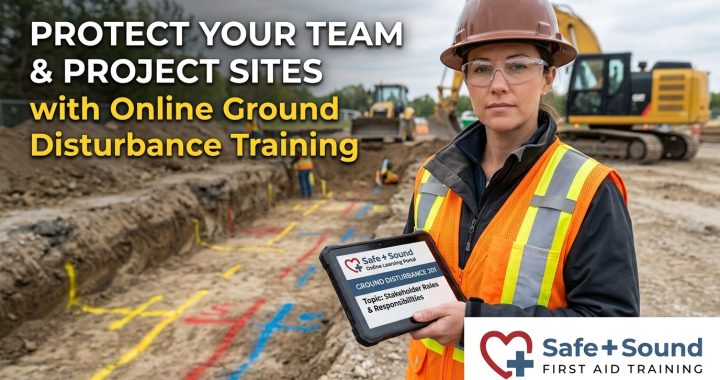
Worker with hard hat on construction site holds a tablet displaying the Safe + Sound Ground Disturbance 201 online course, next to the Safe + Sound logo.

Ground Disturbance 201 Online Course: USP Endorsed Training

Essential Guide to Ground Disturbance 201: Protect Your Team and Project Sites with Online Training

In the construction, utilities, mining, and forestry industries, subterranean hazards are some of the most critical risks on any worksite. Striking a buried facility—whether a high-pressure gas line, electrical conduit, fibre-optic cable, or water main—can lead to severe injuries, catastrophic environmental damage, massive financial penalties, and costly project delays. Damage prevention training is not just a regulatory obligation; it is essential for a healthy workplace safety culture.

To help organizations maintain compliance while balancing busy project schedules, Safe + Sound First Aid Training offers the Ground Disturbance 201 online course. Endorsed by Utility Safety Partners (USP)—formerly the Alberta Common Ground Alliance (ABCGA)—this fully accredited, self-paced training program equips workers, supervisors, and planners with the vital knowledge required to identify subterranean hazards and safely execute excavation operations.

Below, you’ll find everything you need to know about this industry-standard course, including its core curriculum, key benefits, eligible professional credits, and how it empowers your organization to build safer, more compliant job sites.

What is Ground Disturbance 201?

Ground Disturbance 201 is an advanced safety course designed for anyone involved in planning, supervising, or executing ground disturbance operations. A ground disturbance includes any work, operation, or activity that results in the movement or displacement of earth—such as excavating, trenching, digging, drilling, grading, or driving posts.

This online course delivers the same rigorous curriculum and testing criteria as traditional classroom-delivered programs endorsed to the USP Ground Disturbance 201 Standard. Because it is delivered 100% online through Safe + Sound’s user-friendly learning portal, participants can complete their training anytime, anywhere, at their own pace.

Upon successfully passing the final exam (achieving an 80% mark or higher across up to three attempts), learners receive a downloadable, printable certificate valid for three years across participating Canadian jurisdictions. Virtual proctoring is also integrated into the platform via Integrity Advocate to maintain strict academic integrity and meet compliance standards seamlessly.

Key Topics Covered in the Course

The Ground Disturbance 201 curriculum delivers comprehensive, practical instruction across every stage of ground disturbance operations. Throughout the six-hour course, participants explore the following essential modules:

Damage Prevention Fundamentals: Understanding the critical importance of damage prevention, the potential consequences of buried facility damage, and the roles of regulatory bodies, safety associations, and industry publications.
>Stakeholder Roles & Responsibilities: Defining the specific legal and operational responsibilities of all parties involved in a ground disturbance project, including facility owners, project planners, supervisors, locators, and workers.
>Definitions & Codes of Practice: Learning standardized industry terminology, ground disturbance legislation, and essential codes of practice governing safe digging.
>Hazard Assessment & Emergency Response Plans (ERPs): Conducting thorough site hazard assessments and establishing robust, actionable emergency response procedures in case an underground incident occurs.
>Approvals, Agreements & Permits: Navigating necessary regulatory approvals, crossing agreements, proximity agreements, and step-by-step procedures for issuing and utilizing a ground disturbance permit correctly.
>Locating & Searching for Buried Facilities: Conducting pre-work searches, submitting formal locate requests, interpreting various locate marks, and understanding search zone requirements.
>Exposing & Disturbing Underground Infrastructure: Identifying safe mechanical and hand-exposing practices near buried facilities and following proper protocols if damage is caused or discovered.
>Note: For operations in British Columbia, learners can seamlessly complete the optional BC Ground Disturbance 201 Add-on following this course to align fully with provincial requirements.

Who Should Take Ground Disturbance 201?

Because ground disturbance safety impacts every level of an operational project, this course is tailored for a wide range of professionals across multiple sectors. Safe + Sound welcomes individuals of all experience levels and backgrounds to take this vital safety step.

Specifically, this course is for:

Project Planners & Engineers: Professionals who design worksites and must account for underground infrastructure before breaking ground.
Site Managers & Supervisors: Individuals overseeing field operations who issue permits, inspect sites, and enforce safety compliance.
Equipment Operators & Excavators: Tradespeople actively digging, trenching, or operating heavy equipment near buried utilities.
Field Workers & Technicians: Crew members on site who need to recognize locate marks, identify hazards, and react effectively to emergencies.
Water & Wastewater Operators: Utility workers responsible for maintaining subterranean piping systems.

Professional Credits & Continuing Education

Beyond meeting workplace compliance requirements, completing Ground Disturbance 201 offers valuable professional growth opportunities:

Canadian Construction Association Gold Seal Certification: Eligible for 2 Gold Seal credits, helping construction management professionals advance their credentials.
Water & Wastewater Operator Certification: Earns 0.6 CEUs in Alberta and 0.5 CEUs in Saskatchewan toward professional operator recertification.

Features, Benefits, and Advantages of Online Learning

Traditional in-person safety courses can present logistical challenges, such as pulling entire teams off the field simultaneously or incurring steep travel expenses. Safe + Sound’s online training portal solves these challenges by delivering a flexible, modern learning solution.

Flexibility and Convenience: Participants can access course materials 24/7 on any computer with internet access. Learners can pause the training, digest complex information at their own speed, and resume seamlessly where they left off.
Significant Cost Savings: Online learning eliminates expensive travel, hotel stays, per diems, and extended downtime away from the job site. As a result, businesses can train more employees while protecting their operating budget.
>Consistent, High-Quality Content: Every participant receives the exact same standardized instruction, high-definition instructional media, and testing criteria, ensuring uniform safety knowledge across your workforce.
>Integrated Virtual Proctoring: With online webcam monitoring powered by Integrity Advocate, employers can feel completely confident about certification integrity without requiring staff to travel to an exam facility.
Instant Access & Simplified Record Management: Immediately upon course completion, students can download and print their official certificates. Managers and safety coordinators can track team certifications through centralized online record management.

Empower Your Team Today: A Call to Action for Employers

In the construction and utility industries, prevention is always better—and far less costly—than managing a workplace disaster. Investing in accredited safety training empowers your team to work confidently, protect community infrastructure, and ensure everyone returns home safely at the end of every shift.

Do not wait for a near-miss or an unexpected utility strike to prioritize ground disturbance training. Equip your supervisors, operators, and field personnel with industry-leading knowledge today.

Ready to streamline your workforce training? Register your staff for the Utility Safety Partners (USP) Endorsed Ground Disturbance 201 Online Course through Safe + Sound First Aid Training today. Contact our support team at 604.945.7277 or visit our online course portal at online.learnfirstaid.ca/courses/ground-disturbance-201(opens in new tab) to enroll your employees in minutes!

Two young boys at home alone. They are lying on the floor together, chatting and colouring.

Home Alone Online Training for Children

Safe + Sound First Aid Training offers Home Alone online training for children aged 9-13 years old. Here are some of the most frequently asked questions from parents and caregivers about children being home alone.

Q: How can I tell if my child is ready to stay home alone?

Signs Your Child May Be Ready To Stay Home Alone:

While every child matures differently,  some signs indicate your child may be ready to stay home without adult supervision for short periods. These signs will help parents, guardians, and caregivers gauge their child’s readiness.

Your child —

  • is 10+ years of age.
  • follows family rules and instructions.
  • knows his/her full name, address, major intersections and phone number.
  • understands when and how to contact 911.
  • is not afraid to stay home alone.
  • knows what to do when the unexpected arises.
  • has basic first aid skills, knows where the first aid kit is and how to use its contents.
  • knows how to lock the door routinely and safeguard the key.
  • knows how to contact a trusted adult if needed.

Q: What are the benefits of online, self-directed Home Alone classes for children aged 9-13?

There are several benefits to online, self-directed classes on the subject of home alone, safety, and first aid for children aged 10+:

Self-sufficiency: These classes can teach children how to be self-sufficient and take care of themselves if they are home alone.

Safety skills: Children can learn essential safety skills, such as handling emergencies and what to do in the event of an injury.

Independence: These classes can help children develop a sense of independence and responsibility.

Confidence: Children can gain confidence in handling difficult situations by learning new skills.

Fun: These classes can be engaging and interactive, making them more enjoyable for children.

Convenience: Children can complete online, self-directed classes at a time that’s convenient for the child and their family.

Accessibility: Online classes can be accessed from anywhere with an internet connection, making them a convenient option for families who may not have access to in-person classes in their area.


Q: What is the minimum age for leaving children home alone?

Please check your community’s child protection services for local guidelines or laws regarding the recommended minimum age to leave a child home alone. This age varies from province to province and state to state.


Q: What other factors should I consider when deciding if my child is ready to stay home alone?

Parents should be mindful that not all children mature at the same age and that age is not the only factor to consider when deciding a child’s readiness. Temperament, maturity, access to Emergency Medical Services, and willingness are also factors to consider.

Parents should not force a child to stay home alone before they are ready. Taking the Home Alone course will help youths develop many essential safety skills, but it does not guarantee that a child will be prepared to stay on their own. This is a judgment call for parents, guardians and caregivers as they know the child’s abilities best.

The Home Alone Safety for Kids course will help your child prepare for independence. Practical and convenient, this self-guided and self-paced tutorial helps to build a child’s confidence through engaging games, rich digital media, videos and colourful graphics that equip youth with skills for a lifetime of safety. It provides valuable life skills for your child and peace of mind for parents and caregivers.


Q: How long is the online Home Alone course?

The Home Alone Safety for Kids online course takes approximately 90 minutes to complete.


Q: How old do children have to be to take the Home Alone online course?

The Home Alone Safety for Kids online course is designed for children aged 9-13 years.


Q: What topics are included in the online Home Alone course?

The Home Alone Safety Online course has 7 highly visual and interactive learning modules covering:

  • Street smarts and road safety
  • People safety (learning how to spot tricky people and how to get help)
  • At home safety
  • Online safety
  • Fire safety
  • First Aid (Part 1)
    First Aid (Part 2)
  • Accident Prevention

Q: Can I watch a preview video of the Home Alone course?

Yes, click here to see a preview of the Home Alone Safety for kids course.

Q: What is the pass mark for the Home Alone course?

Participants must achieve a mark of 80% to receive a certificate of completion. They can repeat the course twice if they don’t get 80% or more on the first attempt.

Q: Will my child receive a certificate after completing the Home Alone course?

Yes. Your child will receive a digital participation certification after completing the Home Alone course.

Q: After taking the Home Alone online course, will my child be qualified to babysit?

After taking the Home Alone Safety for Kids course, your child will be safer and more confident to stay home alone. If they are planning to babysit, we recommend they also take a Red Cross Babysitting course. You can find more information about this course here: Canadian Red Cross Babysitting Program for 11-15 year-olds.

Q: How can I register my child for the Home Alone course?

Click here to register your child today for the Home Alone Safety for Kids course.

Q: Who can I contact if I have questions about the Home Alone course?

Please contact us here via this form. Thank you.

Home Alone Online Training for Children is an investment in your child’s safety.

injured worker lying slumped against wall with person giving first aid.

WorkSafeBC Accepts Red Cross Blended Emergency First Aid as OFA 1 Equivalent

BC employers will be happy with a recent announcement from the Canadian Red Cross. Effective June 15, 2020, WorkSafeBC accepts Canadian Red Cross Blended Emergency First Aid as OFA Level 1 equivalent.

What is Emergency First Aid?

Emergency First Aid is a Canadian Red Cross training course that includes essential lifesaving first aid and CPR skills for the workplace and home. The course meets legislation requirements for provincial/territorial worker safety and insurance boards. It follows the latest first aid and CPR guidelines.

What does Blended Emergency First Aid mean?

A blended course includes an online component as well as an in-person session. Students complete an online course where they learn the theory behind the first aid skills. Following this, they attend a practical skills class where they get hands-on practice. During this session, they will complete a multiple-choice test.

How does Blended Emergency First Aid benefit employers?

Instead of employees taking a full day off work to attend a classroom-based course, they can now take a half-day. Participants will complete the online portion of the course at home or in the workplace before the classroom session. Workers will have less time away from the workplace. This reduces the need for employers to find cover, saving time and money.

Where does the practical skills session take place?

The Blended Emergency First Aid skills session can take place onsite in the workplace or at a local training venue.

Emergency First Aid Blended – About

Duration

Blended EFA with CPR C (adult, child and infant skills):
4.5 hours in-class + 4 hours online learning**

Regular EFA with CPR C:
7.5 hours in-class

Completion

  • Successfully demonstrate skills and critical steps
  • Min. 75% mark for written knowledge evaluation
  • Attend and participate in 100% of the course

Certification

3-year certification in Emergency First Aid and CPR Level C

Recertification*

EFA with CPR C: 5 hours in-class OR 4 hours in-class + 4 hours online learning**

Hands typing on computer keyboard

Course Content

  • The Red Cross
  • Preparing to respond
  • The EMS system
  • Check, Call, Care
  • Airway emergencies
  • Breathing and Circulation emergencies
  • First aid for respiratory and cardiac arrest
  • Wound care
  • Includes any other content required by specific legislation

Participant Materials

  • First Aid & CPR (eBook)
  • Emergency First Aid – Online (Blended only)
  • Emergency First Aid certificate (digital certificate issued upon successful completion)
  • Printable version – Emergency First Aid

*Recertification not available in all jurisdictions.

**Online learning time will vary depending on the learner.

Interested in Private Group Training for your team? Please contact us and ask for a quote.


Students in first aid class doing CPR wearing face masks.

Onsite Emergency First Aid Training at Vancouver Film Studios. June 2020.

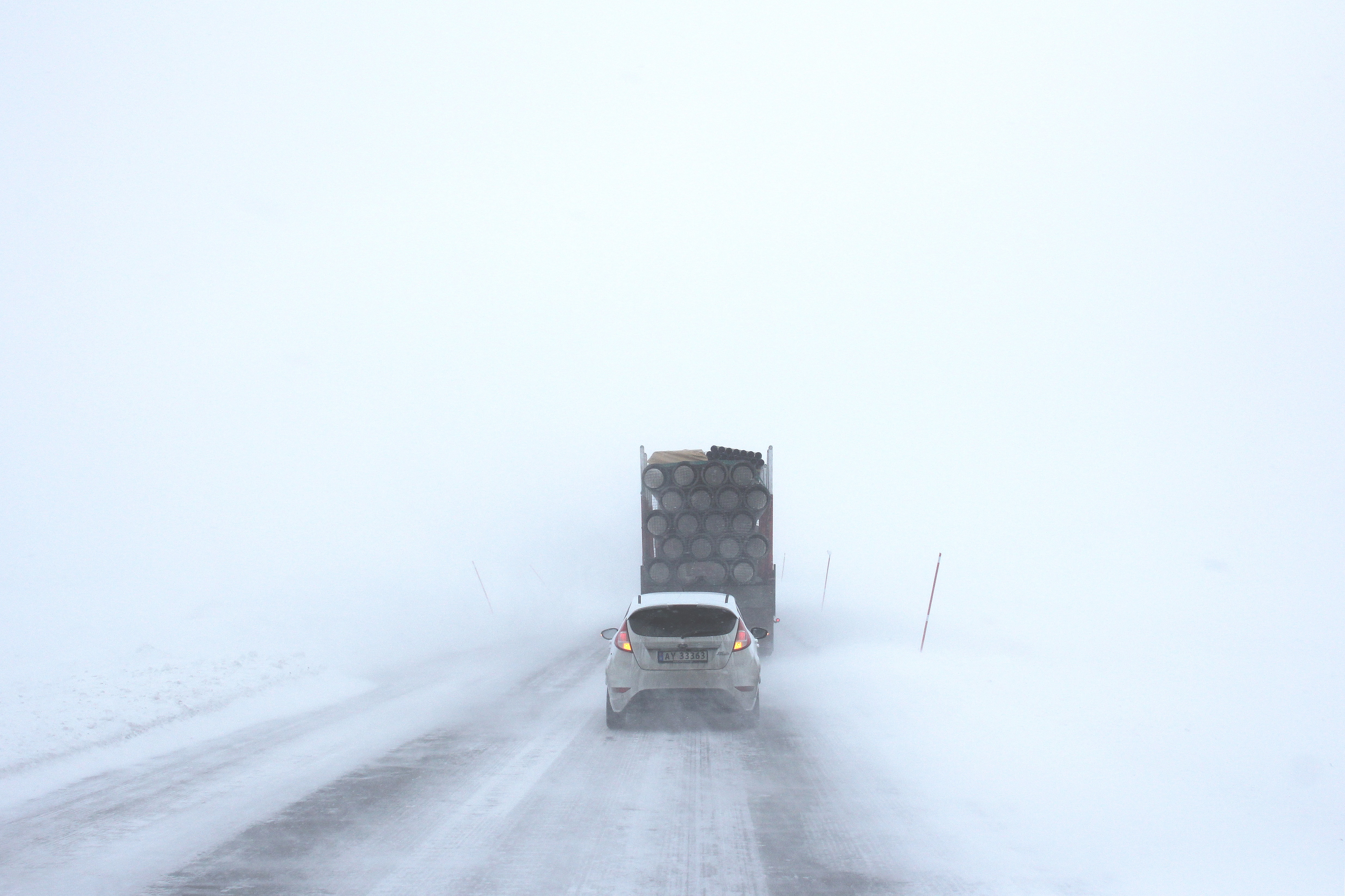
Winter Driving Safety Tips Canada – FAQ’s

Frequently Asked Questions About Winter Driving

For more winter driving safety tips, please see the sources listed below and consider taking an online winter driving safety course.

Q: What are the three key elements to safe winter driving?

A:

  • Stay alert
  • Slow down
  • Stay in control

Q: What are some tips for driving in snow?

A:

  • Stay home. Only go out if necessary
  • Drive slowly
  • Accelerate and decelerate slowly
  • Increase your following distance to five to six seconds
  • Know your brakes
  • Don’t stop if you can avoid it
  • Don’t power up hills
  • Don’t stop when going up a hill

Q: Is a heavier car better in snow?

A: Heavier cars tend to do better in snow and ice than light vehicles. Tires designed for snow and ice not only have tread patterns that help with snow traction but the actual rubber compound they’re made of helps them stay softer and stickier in cold temperatures.

Q: How can I make my car better in snow?

A:

  • For rear-wheel vehicles, add weight to the rear.
  • Drive in the tracks cleared by other vehicles.
  • Get a pair of tire socks.
  • Buy a pair of easy-to-install snow chains.
  • Get winter tires.

Q: What should I do if I start to skid on black ice?

A: If you drive over black ice and start to skid, ease off the accelerator, and look and steer smoothly in the direction you want to go. Don’t brake as this will make the situation worse. You may need to repeat this manoeuvre several times until you regain control.

Q: What can I do if my car gets stuck in the snow?

A: Experts recommend that you remove the snow from around your tires to allow the wheels to roll more freely. If you have something to help your traction (such as traction mats, old carpets, salt, sand or kitty litter), put it right in front of your drive wheels. Gently rock your vehicle back and forth by shifting from forward to reverse, gradually increasing the distance with each rocking motion. Refer to the owner’s manual for more information.

Q: What are Mountain/snowflake tires?

A: If you live or travel in an area where you would typically and regularly expect snow, ice and slush, ICBC recommends using four matched winter tires that carry the mountain/snowflake symbol. Mountain/snowflake tires offer a higher level of traction in harsh winter conditions and receive their special designation for adhering to a performance-based standard (developed by the U.S. Rubber Manufacturers Association and the Rubber Association of Canada). They are the best winter tires available.

Q: Is it OK to use cruise control in winter driving conditions?

A: Avoid using cruise control in wet or slippery conditions. An activated cruise control system will continue to apply power, keeping your wheels spinning. Snow, ice, slush and rain can cause wheel-spin and loss of control. The only way to stop it is to reduce power. By the time you turn off your cruise control, it may be too late for you to get control of your steering again.

Q: How can I prevent hydroplaning?

A: Hydroplaning happens when the tires lose contact with the road surface and float on a film of water, and you lose control of steering and braking. It can occur in rain or standing water. The higher your speed, the greater your chances of hydroplaning. Prevent hydroplaning by scanning ahead for large puddles and reducing your speed, especially during heavy rain. If hydroplaning happens, don’t brake — decelerate and drive straight.

Q: What’s the recommended tread depth for winter tires?

A: ICBC advises that whichever winter tires you choose, it’s essential that they have a minimum tread depth of 3.5 mm. When you’re buying tires, remember to tell your local tire retailer what kind of road and weather conditions you drive in, so you get tires that are best suited for your needs.

Q: How do you know when it’s time to change your winter tires?

A: As a tire’s tread wears away, its traction, cornering and braking are less reliable. Most tires have tread wear indicator bars moulded into the tread face. ICBC recommends you replace your tires when the tread wear indicators in any two adjacent grooves of the tread are contacting the road.

Sources and Additional Resources

DriveBC

Online Training – Winter Driving Safety

To learn more about winter driving safety, take one of our online courses. Chose from the selection below:

If you have questions please contact us

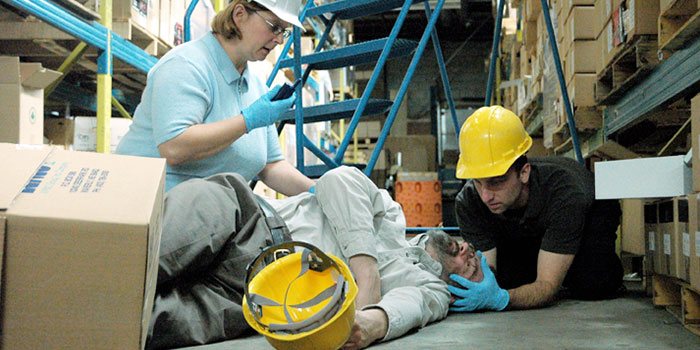
workers providing first aid to injured co-worker

Why get staff trained in first aid?

There are more advantages than you might think.

Most conscientious employers have “Get staff trained in first aid” somewhere on their to-do list. How high up this item appears on the list may depend on their previous experience of accidents and injuries in the workplace or knowledge of the advantages of first aid training.

Safety Training Makes Sense

In workplaces, where employees have suffered severe injuries or death, employers have learned from bitter experience that safety should always be the number one priority. Think about it, if your staff members are trained to check for dangers and deal with hazards, there will be fewer accidents and injuries at your workplace and less downtime. Also, you’ll likely see a boost in morale as workers are happier and more productive if they feel like employers care about their safety.

What about the bottom line?

As well as the human suffering that often results from serious accidents, there will also be an impact on the bottom line. Employers often make decisions based on savings in time and money. If you’re asking yourself the question, “Will getting my staff trained in first aid save me time and money?” the answer is yes!

Don’t learn the hard way

Employers don’t have to learn about the advantages of safety and first aid training the hard way, though. All they need to do is be smart about safety training and practices and make arrangements for their staff to get trained through a recognized course provider.

Online or Classroom Training?

All employees need safety training. Workers can complete some of this online, but for first aid, you need to send your people to a classroom-based course. With first aid and CPR training, there is no substitute for getting hands-on experience working with a CPR mannequin, AED and other first aid equipment and supplies. In a classroom setting, participants get expert instruction and direct feedback from a certified instructor.

Use the Services of a recognized Training Provider

The Canadian Red Cross has been offering first aid and CPR training to Canadians for over 50 years and is one of the leading providers of first aid and CPR programs in Canada. Safe + Sound First Aid Training is proud to have been a Canadian Red Cross Training Partner since 1999. The Red Cross courses and certifications we offer are nationally recognized and accepted in BC by Child Care Licensing, Adult Care Licensing and WorkSafeBC.

Eight reasons to get your staff trained in first aid & CPR

  1. It saves lives!
  2. It will save you money. Less downtime = increased productivity.
  3. Your workers will be safer in and outside of the workplace.
  4. Employees will be able to act quickly, confidently and effectively in emergencies.
  5. Your worker safety and insurance board will be pleased with you.
  6. It’s a great team-building exercise.
  7. You’ll see an increase in morale; people like to work for employers who care about their safety.
  8. You’ll have one less thing on your “to-do” list, and maybe you’ll sleep better at night.

Group First Aid Training is Easy to Organize

Providing first aid and CPR training for employees is a smart, low-cost investment that helps ensure workplace health and safety. If you’re thinking about organizing first aid and CPR training in your workplace, please contact us, or complete our Group Training Form and we’ll be happy to help.

Gill McCulloch

Safe + Sound First Aid Training

learnfirstaid.ca

604-945-7277