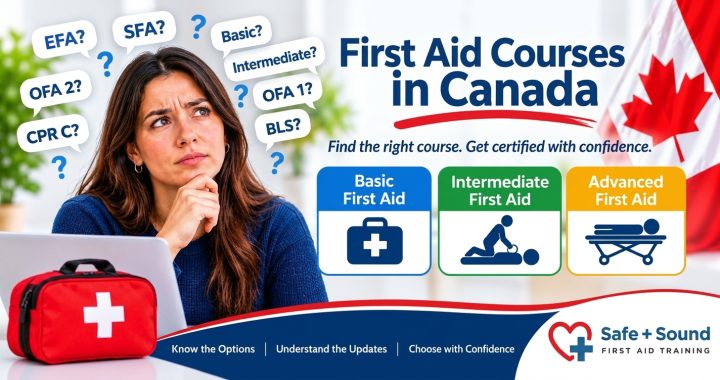
When you search for safety training in Canada, Google fills your screen with a confusing mix of acronyms: EFA, SFA, Basic, Intermediate, OFA 1, OFA 2, CPR C, and BLS.
If you have found yourself typing “What first aid course do I need for work?” or “What replaced OFA Level 1 in BC?”, you are far from alone. Tens of thousands of Canadians search these exact phrases every month to figure out which certification satisfies their workplace, school, or personal requirements.
Navigating these regulations does not have to be confusing. This guide answers the most common search questions typed by Canadians, breaks down updated regulatory terminology, and helps you select the exact course required for your situation.
1. Which First Aid Course Should I Take?” (Matching Levels to Your Needs)
Choosing the correct training level depends on your role, your industry, and your employer’s requirements. Here is how Canada’s core first aid levels compare:
Basic First Aid (Formerly Emergency First Aid / OFA Level 1)
Duration: 1 Day (approx. 7–8 hours)
Who Needs It: General office workers, retail staff, fitness instructors, light duty tradespeople, and smaller low-hazard workplace teams.
What You Learn: Immediate, life-saving care. Topics focus on scene assessment, CPR and Automated External Defibrillator (AED) operation, choking relief, severe bleeding control, shock management, and basic wound care.
Intermediate First Aid (Formerly Standard First Aid / OFA Level 2)
Duration: 2 Days (approx. 14–16 hours) or Blended format (online theory + 1-day practical assessment).
Who Needs It: Designated workplace first aid attendants, heavy construction workers, manufacturing staff, aquatic personnel, daycare providers, and anyone wanting comprehensive preparation.
What You Learn: Comprehensive emergency management. Covers everything in Basic First Aid plus head, neck, and spinal trauma, bone/joint immobilization, sudden medical emergencies (such as heart attacks, strokes, diabetic reactions, and seizures), environmental illnesses, and poisoning.
Advanced First Aid (Formerly OFA Level 3)
Duration: 10 Days (approx. 70–80 hours)
Who Needs It: Industrial attendants operating on high-hazard, large-scale, or remote sites located more than 20–30 minutes from paramedic emergency response.
What You Learn: Advanced trauma evaluation, oxygen administration, extended patient care management, and emergency transport protocols.
2. What Replaced OFA Level 1 and Level 2 in BC?” (WorkSafeBC Updates)
If you last took a first aid course a few years ago, the terminology on your certificate might look out of date.
To align with national Canadian Standards Association (CSA Z1210-17) guidelines, WorkSafeBC officially updated occupational first aid titles:
OFA Level 1 is now called Basic First Aid (1-day course).
OFA Level 2 is now called Intermediate First Aid (2-day course).
OFA Level 3 is now called Advanced First Aid (10-day course).
The Big Advantage for Employers
Under the old system, earning an OFA Level 2 credential required a demanding 35-hour (5-day) training commitment. Under the current CSA framework, WorkSafeBC accepts 14-hour (2-day) Intermediate First Aid as the equivalent of OFA Level 2. This saves local businesses significant time and operational costs while maintaining rigorous emergency response standards.
Note on Certificate Expiry: If your team holds valid older “OFA” certificates, they remain fully recognized by WorkSafeBC until their printed expiration date. When renewing, simply register for the corresponding CSA title (Basic, Intermediate, or Advanced).
3. What is the Difference Between CPR Level A, Level C, and BLS?
Many people ask if CPR-only training is sufficient, or wonder what the letter designations mean.
CPR Level A: Covers resuscitation and choking techniques for adults only.
CPR Level C: Covers resuscitation and choking techniques for adults, children, and infants. This is the most popular, versatile standard across Canada and comes included with most Canadian Red Cross Intermediate First Aid programs.
Basic Life Support (BLS): Formerly known as CPR HCP, BLS is designed specifically for healthcare professionals and emergency responders (nurses, paramedics, dental teams, and firefighters). It focuses on team-based resuscitation, high-performance CPR, pulse checks, and bag-valve-mask (BVM) ventilation.
4. What First Aid Course Do I Need for My Specific Job?
Different industries follow distinct regulatory baselines across British Columbia and Canada:
- Daycare Workers & Early Childhood Educators (ECE): Requires specialized pediatric first aid such as Emergency Child Care First Aid with CPR Level B or Intermediate First Aid with CPR Level C.
- Construction & Industrial Trades: Basic First Aid (OFA 1) is the minimum for small crews in urban areas. Larger crews or sites with higher hazard ratings require designated attendants holding Intermediate First Aid (OFA 2) or Advanced First Aid (OFA 3).
- Healthcare Students (Nursing, Paramedicine, Dental): Most post-secondary admissions require Intermediate First Aid paired with CPR Level C or Basic Life Support (BLS).
Fitness Trainers & Coaches: Usually require Basic First Aid with CPR Level C and AED certification.
5. Can I Take My First Aid Course Fully Online in BC?
This is one of the single most frequent search queries typed by busy professionals.
The short answer: You cannot earn a valid WorkSafeBC or Red Cross First Aid certification through a 100% online course. Hands-on skill evaluation on CPR manikins and bandaging practice are mandatory regulatory requirements.
The modern solution: Blended Learning.
Blended training provides the ideal middle ground for busy schedules:
Digital Theory: You complete the theoretical coursework self-paced on your computer or tablet via an online learning portal.
In-Person Assessment: You attend a streamlined classroom session to practice and evaluate your hands-on practical skills with a certified instructor.
This approach cuts your required classroom time in half without sacrificing credential validity or WorkSafeBC recognition.
6. How to Select the Best First Aid Provider in Metro Vancouver
Once you know which course level you require, choose a training center that ensures a supportive and efficient learning experience:
Look for Official National Accreditation
Verify that your provider is an authorized partner of a recognized national body like the Canadian Red Cross. This guarantees your certification is transferable across Canada and compliant with all provincial health and safety regulations.
Prioritize Stress-Free, Practical Instruction
Learning first aid should build confidence, not anxiety. Choose providers with instructors who prioritize hands-on practice, activity-based scenario training, and supportive coaching.
Confirm Fast Digital Certification Delivery
Ensure your provider issues official digital certification promptly after course completion so you can provide immediate proof of compliance to your manager or school admissions team.
Summary – Deciding Which First Aid Course to Take
Need 1-day workplace compliance in BC? Book Basic First Aid (OFA 1 equivalent).
Designated first aid attendant or work in high-risk trades? Book Intermediate First Aid (OFA 2 equivalent).
Entering healthcare or nursing school? Book Intermediate First Aid + BLS.
Busy schedule? Choose a Blended Learning format.
Get Certified with Safe + Sound First Aid Training
Whether you need in-person group instruction in Metro Vancouver, flexible blended learning, or workplace safety compliance, Safe + Sound First Aid Training Ltd. makes earning your certificate simple and stress-free.
As a trusted 27-year Canadian Red Cross Training Partner, Safe + Sound delivers WorkSafeBC-approved Basic and Intermediate First Aid, specialized CPR/BLS sessions, and an extensive online catalog of workplace safety modules.
Browse classroom and blended schedules: Visit www.learnfirstaid.ca
Explore online safety courses: Get started at online.learnfirstaid.ca