A photograph of a young person in a red hoodie and over-ear headphones at a dark wood computer desk, looking at a large monitor displaying a Zoom video call presentation. On the computer screen, a detailed presentation slide is titled "CANADIAN RED CROSS BABYSITTING COURSE TOPICS" followed by a bulleted list: "Rights & Responsibilities of a Babysitter;", "Child Development & Care;", "Understanding Children's Behavior;", "Injury Prevention;", "First Aid Skills;", and "The Business of Babysitting." A small Red Cross logo and text are below the list. On the desk are a realistic training baby manikin in a onesie and an open "Babysitting" training manual. A banner overlay at the bottom of the image reads "Hosted by", with a heart-and-cross logo for "Safe + Sound FIRST AID TRAINING" alongside a "Canadian Red Cross Training Partner" logo with a red cross.

Is Your Child Ready to Babysit? What Online Red Cross Training Teaches Beyond First Aid

Online Red Cross Babysitting Course

Stepping into a caregiving role is an exciting milestone for pre-teens, but it often brings a touch of parental anxiety. Enrolling your child in an online Red Cross babysitting course transforms that hesitation into real caregiving confidence. Through interactive, live virtual sessions, pre-teens (ages 11–15) master essential first aid, home safety, and practical child care skills—all from the comfort of home. Help your youth build life-saving skills, earn their official certification, and step into their first caretaking job with total peace of mind.

View Upcoming Virtual Class Dates & Register Today.

Frequently Asked Questions: Virtual Babysitting Training in Canada

Q1: What is the minimum age requirement for an online babysitting course in Canada? A: Youth must be at least 11 years old (or have completed Grade 5) up to 15 years old. This age threshold ensures participants possess the emotional maturity required for caregiving concepts.

Q2: Is a virtual babysitting class as effective as an in-person workshop? A: Yes. Live, instructor-led virtual classes use real-time webcams, physical practice with props (dolls or stuffed animals), and interactive group scenarios to ensure students master hands-on skills just as effectively as in a physical classroom.

Q3: Are virtual Canadian Red Cross babysitting certificates recognized by parents and employers? A: Official Canadian Red Cross completion certificates carry nationwide recognition and credibility among parents and community organizations, regardless of whether the delivery format was virtual or in-person. The certificates are widely recognized by parents as proof of training, but they are generally viewed as youth participation credentials rather than formal employment-mandated workplace qualifications. Professional nanny agencies or commercial daycare employers typically require formal, in-person workplace certifications like Emergency Child Care First Aid or Intermediate First Aid rather than a youth babysitting certificate.

Q4: Does virtual training teach real emergency first aid and CPR? A: The standardized Red Cross curriculum covers hands-on management of choking, infant and child CPR awareness, allergic reactions (including EpiPen administration), asthma inhaler use, burns, bleeding, and head/neck injuries. The course offers an excellent introduction to first basic first aid.

Q5: Will my child learn how to care for infants and toddlers, not just school-aged kids? A: Yes. The Canadian Red Cross Babysitting course covers the developmental stages from infancy through age 10, teaching practical techniques for diapering, safe infant holding, bottle feeding, soothing techniques, and age-specific play.

Q6: How does an instructor assess physical skills like choking rescue over a webcam? A: Instructors conduct live visual checks where each student follows along by demonstrating back blows and chest thrusts on a doll or plush toy, allowing the instructor to provide real-time guidance and corrections. If your child needs a first aid certification that requires passing a physical test on a CPR manikin in addition to a written knowledge test (often required for child care workers or day camp counsellors), they may need to register for an in-person Intermediate First Aid course. In addition to child care skills, the virtual Babysitting course teaches youth about home safety, accident prevention and emergency response designed specifically for youth.

Q7: How does the training help youth manage severe tantrums or difficult behaviour? A: The curriculum teaches positive behaviour management strategies, active listening, transition routines, and conflict resolution techniques customized to a child’s developmental stage.

Q8: What home safety and hazard prevention skills are taught? A: Students learn how to conduct home safety sweeps to identify hazards like unsecured poisons, hot liquids, open windows, sharp objects, and fire hazards before accidents happen.

Q9: Can an 11- or 12-year-old legally babysit on their own in Canada? A: While provincial guidelines regarding leaving children unattended vary across Canada, completing a recognized Red Cross course establishes measurable readiness, competence, and parental trust.

Q10: How long does a virtual Red Cross Babysitting course take? A: The standard duration is 7 to 8 hours, delivered either as a single full-day session or broken into two multi-hour live virtual modules.

Q11: What supplies or equipment does my child need at home for the course? A: Participants require a device with a working camera and microphone, stable internet, a baby doll or stuffed animal, a kitchen towel (for bandaging drills), and writing materials. The company hosting the course will send a list of required materials (most of which can be found in the home) before the training.

Q12: Does the course cover emergency situations like fires, power outages, or strangers? A: Yes. Youth learn personal safety rules, how to respond to unexpected callers or visitors, fire escape planning, severe weather safety, and precisely when and how to call 911.

Q13: Will my child learn safe kitchen practices and meal preparation? A: Yes. Students learn safe snack assembly, kitchen safety guidelines, identification of high-risk choking foods (e.g., whole grapes or hot dogs), and cross-contamination prevention for food allergies.

Q14: How does the course teach the business side of babysitting? A: Participants learn professional conduct, how to build a simple babysitting resume, setting fair compensation rates, conducting client intake interviews, and negotiating safety boundaries with hiring parents.

Q15: Does the Red Cross provide physical or digital manuals for virtual students? A: Yes. Registered students receive access to the official Canadian Red Cross Babysitter’s Manual in digital format as well as a physical copy in the mail.

Q16: How does this training help an anxious or shy child gain confidence? A: Through guided decision-making exercises, role-playing parent scenarios, and structured safety frameworks, youth transition from hesitation to clear, assertive leadership.

Q17: What is the difference between Red Cross “Stay Safe!” and the “Babysitting” course? A: Stay Safe! (ages 9–13) focuses on home-alone self-care and personal safety. Babysitting (ages 11–15) focuses on taking responsibility for other children, advanced caregiving, and first aid.

Q18: What if my child feels overwhelmed by first aid topics? A: Certified Red Cross instructors use supportive, age-tailored teaching methods that focus on simple, empowering action steps rather than intimidating medical jargon.

Q19: How do I verify that an online course provider is legitimate? A: Ensure the provider is listed as an authorized Canadian Red Cross Training Partner. Legitimate providers like Safe + Sound First Aid Training Ltd., issue official Red Cross completion certificates verified through the Red Cross portal.

Q20: Why choose a Canadian Red Cross course over free online videos or non-certified courses? A: Free videos lack certified live oversight, interactive skill verification, and updated Canadian emergency standards. Red Cross certification delivers structured, proven instruction that gives parents and caregivers complete peace of mind.

Registering your child in a Canadian Red Cross Babysitting course bridges the gap between basic interest and true caregiving readiness. By combining practical life skills—such as child care, behaviour management, and self-marketing—with life-saving first aid training, the curriculum establishes a complete foundation of responsibility. Parents and client families gain genuine peace of mind knowing the young caregiver on duty possesses recognized training to prevent hazards, manage everyday child care challenges, and respond decisively in an emergency.

Give Your Pre-Teen the Confidence to Care for Others Safely. Help your child earn their official Canadian Red Cross Babysitting Certification from home in a fun, live virtual environment.
View Upcoming Virtual Class Dates & Register Today.

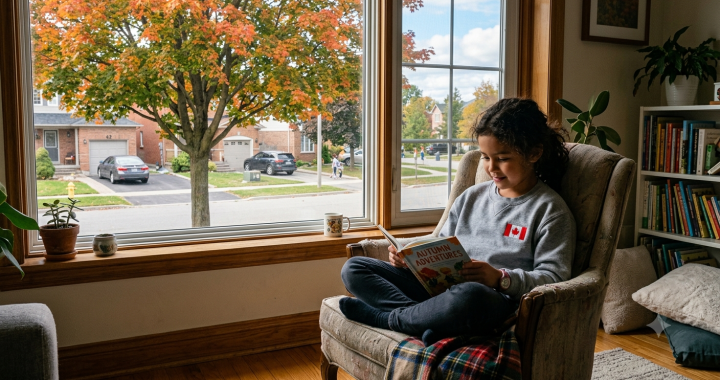
A child sitting reading a book in a chair by the window in a Canadian neighbourhood. A maple tree stands outside the window.

When Can Kids Stay Home Alone in Canada? Age Laws & FAQs

As your child grows, there comes a turning point every Canadian parent faces: the transition to independence. You might find yourself asking, “Can I leave my 10-year-old alone while I run to the grocery store?” or “Is it legal for my middle-schooler to be home after school by themselves?”

The shift toward self-care is an exciting milestone, but it brings up a lot of legal, safety, and emotional questions.

This comprehensive guide breaks down the legal age requirements across Canada, how to gauge your child’s maturity, and how to get them fully prepared using convenient online home alone safety training.

🏛️ The Legal Side: What Does Canadian Law Say?

Many parents are surprised to learn that there is no single federal legal age at which a child can be left home alone in Canada. Instead, the rules vary significantly depending on the province or territory you live in. In fact, only a few provinces explicitly state a minimum age in their child welfare legislation:

Manitoba: Legally requires children to be at least 12 years old before they can be left unattended.
New Brunswick: Also specifies a minimum age of 12 years.
Ontario: The Child, Youth and Family Services Act states that a person who has charge of a child less than 16 years of age cannot leave them without making provision for proper care or supervision. While it doesn’t mean a 13-year-old can never be alone, it puts a high legal responsibility on the parent to ensure the child is safe and not “at risk.”
What about the other provinces?
In British Columbia, Alberta, Saskatchewan, Quebec, and the Atlantic provinces, the law is technically “silent” on an exact number. Instead, child protection laws focus on neglect and safety.

If a child is left in a situation that endangers their well-being, a parent can be held legally accountable, regardless of the child’s age. Case law and Canadian courts have generally ruled that children under 10 years old do not have the cognitive capacity to handle emergencies safely on their own.

📋 At What Age Can I Leave My Child at Home Alone?

Because the law relies heavily on context, Canadian safety organizations provide these standard recommendations for various age groups:

Under 10 Years
Should never be left home alone, even for short periods.
10 – 12 Years
Can stay alone for short daytime periods (up to 1–2 hours), provided they are mature enough and have a trusted adult nearby.
13 – 15 Years
Can stay alone for longer periods during the day or evening, but not overnight.
16 Years +
Generally capable of staying alone for extended periods and managing overnight stays.

❓ Home Alone: Frequently Asked Questions (FAQs)

1. How do I know if my child is ready to stay home alone?
Age is just a number; maturity is what matters. To assess your child’s readiness, ask yourself:

  • Can they follow household rules without constant reminders?
  • Do they know their full name, address, phone number, and how to call 911?
  • Do they understand basic first aid?Crucially: Do they feel safe and comfortable staying alone, or do they feel anxious? If a child is frightened, they are more likely to panic in an emergency.

2. Can my 11-year-old babysit their younger siblings?
The Canada Safety Council notes that being home alone is very different from being responsible for another human being. While an 11-year-old may safely manage themselves for an hour, supervising a younger sibling adds immense stress. It is recommended that children be at least 12 years old and have completed a certified Babysitting Course before looking after younger children. The Canadian Red Cross Virtual Babysitting course is an excellent, convenient option for children aged 11-15 years.

3. What rules should I set before leaving children at home alone?
Clear boundaries prevent accidents. Establish firm rules regarding:

The Door: Never open the door to anyone (even delivery drivers) unless explicitly arranged by a parent.
The Kitchen: Prohibit the use of the stove, oven, or sharp knives. Stick to no-cook snacks.
Digital Boundaries: Define what devices and websites they are allowed to use.
Check-ins: Set a strict rule that they must text or call you the exact moment they walk through the door from school.

4. Is there a course children can take to prepare to be home alone?
Yes! Preparing your child is a gradual process, and structured training makes a massive difference. One of the best Home Alone programs in Canada is The Home Alone Safety for Kids Online Course(opens in new tab) (for kids 9-13)

💻 Why Online Home Alone Training is the Best Option

Gone are the days of trying to coordinate weekend schedules to drop your child off at a community center for a safety seminar. Today, online home alone training offers interactive, expert-led safety education right from the comfort of your own living room.

The Benefits of Online Home Alone Training:
Learn at Their Own Pace: Kids can pause, rewatch, and absorb the material without feeling rushed.
Interactive Learning: Modern online courses utilize engaging videos, quizzes, and digital workbooks that keep a child’s attention far better than a standard lecture.
Done Together: Parents can sit alongside their children, allowing them to customize the safety scenarios to their specific household rules and neighbourhood.

What Online Safety Courses Teach:
A quality Canadian online safety course covers vital independence skills, including:

The responsibilities of being on your own.

  • Street smarts and road safety.
  • At home safety.
  • Fire safety protocols, including a home escape plan.
  • Accident prevention.
  • Basic First Aid skills (treating minor cuts, burns, or dealing with a choking hazard).
  • How to handle unexpected situations.

🚀 The Bottom Line

Giving your child the key to the front door is a proud moment, but true peace of mind comes from knowing they are prepared for the unexpected. By understanding your province’s guidelines, assessing your child’s unique maturity level, and investing in a structured online home alone safety course, you can confidently give your child the tools they need to step safely into their independence.

Are you ready to take the next step toward your child’s independence? Explore our certified, interactive online safety program today to ensure your child is prepared, confident, and secure.

Click here for Home Alone course information and a short introductory video.

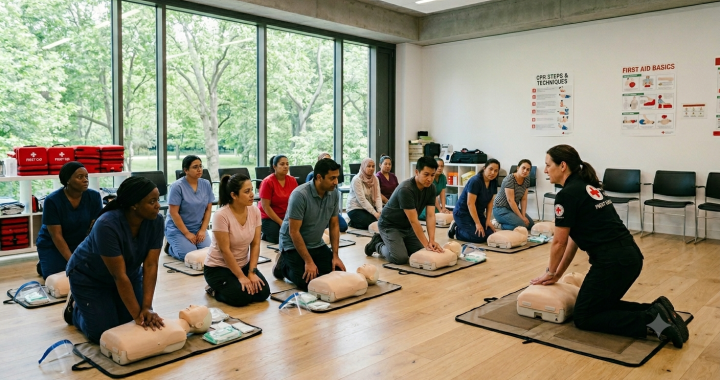
In a spacious classroom with large windows and view of trees, child care workers from a variety of cultures perform cpr in a first aid classroom. The instructor is wearing a t-shirt with a Red Cross logo The child care workers are kneeling on the floor with a CPR manikin looking at the instructor as she demonstrates CPR.

First Aid Certification for Tri-Cities Child Care Workers

Supporting Tri-Cities Child Care Workers with Budget-Friendly First Aid Training in Coquitlam

As a child care professional in the Tri-Cities, you have the immense responsibility of keeping our community’s youngest members safe. Whether you are managing a bustling daycare centre in Coquitlam, organizing outdoor play at a preschool in Port Coquitlam, or running a licensed home-based child care program in Port Moody, you know that children are unpredictable.

From minor scrapes on the playground to sudden medical emergencies, crises don’t give warnings. When an emergency happens, the clock starts ticking.

Are you fully prepared to act?

For child care workers across the Tri-Cities and beyond, maintaining an up-to-date, compliant, and comprehensive first aid certification isn’t just a regulatory checkbox—it is a foundational pillar of professional practice. If you need to renew your certification or are stepping into the field for the first time, Safe + Sound First Aid Training Ltd. is here to ensure you gain the skills, confidence, and official credentials you need.

Meeting BC Child Care Licensing Requirements

In British Columbia, the standards for child care safety are rightfully stringent. Under the BC Child Care Licensing Regulation, individuals working in licensed child care facilities must hold a valid first aid certificate acceptable to the local health authority.

The Canadian Red Cross Emergency Child Care First Aid course is specifically designed to meet and exceed these rigorous BC Child Care Licensing requirements. Securing this certification proves to licensing officers, facility managers, and parents that you are trained in the exact protocols required to save a child’s life. It covers the crucial differences between treating adults and treating infants or children—nuances that are absolutely vital when every second counts.

Why Choose Safe + Sound First Aid Training Ltd.?

When it comes to first aid training, experience matters. You aren’t just trying to pass a test; you are learning how to handle real-world emergencies.

1. 27 Years of Trusted Local Expertise
Established in 1999, Safe + Sound has been a cornerstone of safety education in British Columbia for 27 years. As a dedicated Red Cross Training Partner, we have spent nearly three decades perfecting our curriculum delivery, building community trust, and training thousands of educators, parents, and workers. When you train with us, you are training with an established local institution.

2. Experienced, Certified Instructors
A course is only as good as the person teaching it. Safe + Sound instructors are fully certified by the Canadian Red Cross and bring years of practical, real-world experience to the classroom. They understand the unique dynamics of child care environments. Our instructors don’t just read from a manual; they use engaging, hands-on scenarios, interactive practice, and supportive feedback to ensure you actually absorb the material.

3. Public and Private classes in convenient locations
We know your schedule is packed. That’s why we make accessing our courses as seamless as possible:

Public Classes in Coquitlam: We host regular, easily accessible public training sessions right here in Coquitlam, minimizing your commute. Our venue has plenty of free parking with easy access to local transit routes.

Private Group Training: If you run a daycare centre, preschool, or community hub in Coquitlam, Port Coquitlam, Port Moody, or anywhere across Metro Vancouver, we can bring the classroom to you. Our private group training allows your entire team to get certified together at your own facility, on a schedule that works best for your operations. If you don’t have a suitable training room, no worries. We can teach your team at our Coquitlam venue.

4. Affordable, Transparent Pricing

Budgets matter both for individual educators and child care businesses. Safe + Sound offers highly competitive pricing tailored to our local market. Our public Emergency Child Care First Aid course is priced at just $98.00 per person. There are no hidden fees—just high-quality, lifesaving education at a rate that respects your wallet.

5. Long-Lasting Peace of Mind

Upon successful completion of the course, your Canadian Red Cross Emergency Child Care First Aid certification is valid for 3 years. This gives you long-term professional peace of mind, knowing your compliance and safety credentials are secure for the foreseeable future.

What You Will Learn

The Emergency Child Care First Aid course is a comprehensive program tailored specifically to the illnesses and injuries common among infants and children. Over the course of the training, you will master:

  • The Emergency Action Plan: How to assess a scene quickly, manage bystanders, and activate Emergency Medical Services (EMS) efficiently.
  • Child & Infant CPR: Step-by-step techniques for cardiopulmonary resuscitation tailored to smaller bodies.
  • Automated External Defibrillator (AED) Training: How to confidently deploy and use an AED on a child or infant.
  • Choking Management: Lifesaving physical interventions to clear airway obstructions in babies and young children.
  • Injury Management: How to treat severe bleeding, burns, fractures, and head, neck, or spinal injuries.
  • Medical Emergencies: Recognizing and responding to sudden medical crises, including acute allergic reactions (anaphylaxis and EpiPen usage), asthma, seizures, and poisoning
  • Environmental/Psychological Care: Managing heat and cold illnesses, while learning how to keep a child calm and reassured during a frightening event.

Tri-Cities Parents Trust You

Parents in Coquitlam, Port Coquitlam, and Port Moody entrust you with their most precious treasures every single day. When a parent drops their child off at your facility, their primary expectation is safety. Holding a Red Cross certification from a trusted provider like Safe + Sound tells those parents that their children are in the safest possible hands. It elevates your professional standing, enhances your resume, and boosts your day-to-day confidence in the workplace. Don’t wait until your current certificate expires, and don’t leave your safety education to chance with an unverified training provider. Join the thousands of Tri-Cities professionals who have trusted Safe + Sound to keep them prepared, compliant, and confident.

Ready to Register?
Secure your spot in our next public class in Coquitlam, or connect with us to book a private group training session for your staff across the Tri-Cities and Metro Vancouver.

Website: learnfirstaid.ca
Course: Canadian Red Cross Emergency Child Care First Aid
Investment: $98.00 per person (Certificate valid for 3 years)
Course dates: Click on the following link to browse our Emergency Child Care First Aid course schedule and register online today!

Protect the children in your care, satisfy your licensing requirements, and gain the ultimate peace of mind with Safe + Sound First Aid Training Ltd.

Young children play in a beach sand hole. Parents sit close by in beach chairs. Colourful toys are scattered around.

Why Sand Holes Can Be Deadly

If you’re heading to the beach, you need to learn why sand holes can be deadly. Experts advise parents to avoid digging sand holes as they can be a death trap for kids, adults and animals.

The article below discusses:

  • Why sand holes are so dangerous
  • Where sand holes are found
  • The maximum safe size of a sand hole
  • Alternate activities for kids
  • How to keep kids safe
  • What to do with sand holes before leaving the beach
  • How to rescue a person trapped in a sand hole
  • What to do if you see a large sand hole.
  • Risky social media challenges
  • How to raise awareness about the dangers of sand holes

Read the full article here: Beach Sand Holes: The Deadly Risks and How To Avoid Them


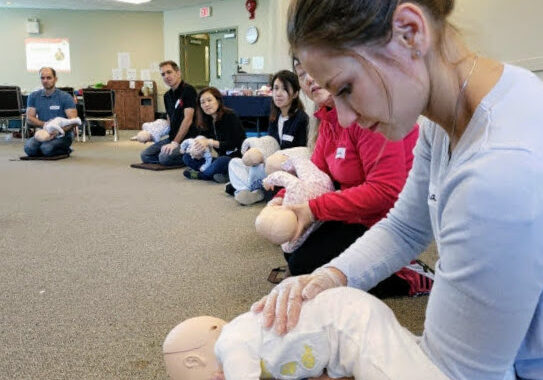
A first aid course student holding a baby CPR manikin. Emergency Child Care First Aid FAQs

Emergency Child Care First Aid FAQs

Are you a child care worker, parent, grandparent or babysitter living in the Coquitlam area? If so, you need first aid training. Red Cross Emergency Child Care First Aid & CPR B is the best course for you. Please read our Emergency Child Care First Aid FAQs, visit our Emergency Child Care First Aid page or contact us. We look forward to seeing you in one of our classes soon.

About Emergency Child Care First Aid & CPR Level B

Q: What is Emergency Child Care First Aid & CPR Level B?
Red Cross Emergency Child Care First Aid & CPR Level B is a one-day course introducing caregivers to injury prevention skills and knowledge. The class covers lifesaving first aid skills and cardiopulmonary resuscitation (CPR and AED) for children and babies. Emergency Child Care First Aid & CPR meets legislation and safety requirements for provincial/territorial early childhood education and child care workers. It is recognized by BC Child Care Licensing for child care workers and ECE students in British Columbia.

Q: Who should take Emergency Child Care First Aid & CPR B?
Emergency Child Care First Aid & CPR B is designed for child care workers and parents. Anyone caring for a baby or young child can benefit from this training, including siblings aged 12+, grandparents and adult babysitters.

Q: I am an Early Childhood Education (ECE) student. Is Emergency Child Care First Aid & CPR B the right first aid course for me?
Yes. Most ECE students take Emergency Child Care first aid & CPR B. You can confirm this with your school before registering for a first aid course.

Q: Does Red Cross Emergency Child Care first aid include CPR Level B?
Yes. The Canadian Red Cross Emergency Child Care first aid & CPR course includes CPR Level B.

Q: Does Emergency Child Care first aid include AED (defibrillator) training?
Yes. The Canadian Red Cross Emergency Child Care first aid & CPR course includes AED training.

Q: Are there any prerequisites for the Canadian Red Cross Emergency Child Care first aid course?
There are no prerequisites for the Canadian Red Cross Emergency Child Care course. Adults and children aged 12 years and up can take Red Cross Emergency Child Care first aid & CPR.

Q: How long is the course?
The Canadian Red Cross Emergency Child Care first aid & CPR course includes eight hours of training plus breaks. When you attend the course, expect to be at the course location for approximately nine hours. BC Child Care Licensing requires child care workers to take a first aid course which includes at least eight hours of instruction.

Q: What topics does Red Cross Emergency Child Care CPR B course include?

Red Cross Emergency Child Care First Aid includes the following topics:

  • The Red Cross
  • Responding to Emergencies
  • The EMS system
  • Check, Call, Care
  • Airway emergencies
  • Breathing and Circulation emergencies – Child and baby
  • First aid for respiratory and cardiac arrest – Child and baby
  • Wound care
  • Head, Neck and Spinal Injuries
  • Bone, Muscle, and Joint Injuries
  • Sudden Medical Emergencies
  • Environmental Illness
  • Poisons
  • Caring for Children

Emergency Child Care First Aid & CPR classes in Coquitlam

Q: Where can I find an Emergency Child care First Aid course schedule for Coquitlam classes?
Please click here for Emergency Child care First Aid courses in Coquitlam.


Private Group First Aid & CPR Training

Q: I run a child care centre, and my workers need first aid training. How can I book a group training session?
Please contact us about booking a private group Red Cross Emergency Child Care First Aid & CPR B course at our Coquitlam classroom. We will gladly provide information, including available dates and a quote for your training.


Emergency Child Care First Aid & CPR Training in BC

Q: According to the BC Child Care Licensing Regulation, what are the requirements for first aid training?
See Schedule C “First Aid” of the BC Child  Care Licensing Regulation

Q: Where can I find the BC Child Care Licensing Regulation?
BC Child Care Licensing Regulation Scroll down the document to “Schedule C” – First Aid.

Q: Are there any virtual classes for baby or child first aid and CPR?
BC Child Care Licensing does not accept online or virtual training in place of in-person first aid & CPR training. There are online courses for those looking to refresh their memory between first aid classes.


FAQ’s About CPR Levels

Q: What does Red Cross CPR level B cover?
Red Cross CPR level B covers skills for the infant (0-1 year) and child (1-8 years). If you work with older children, we recommend you take Standard First Aid & CPR Level C. This course covers skills for all age groups, including adults and meets BC Child Care Licensing requirements for child care workers.

Q: Which level of CPR do I need if I care for children aged eight years and up?
People caring for children older than eight years need a course that includes CPR level C. CPR C covers skills for all ages – infant, child and adult. If you work with older children, we recommend you take Intermediate First Aid, which includes CPR Level C.

Q: What is the difference between CPR levels A, B and C?
CPR A covers skills for adults only.
CPR B covers skills for babies and children aged 0-8 years.
CPR C covers skills for babies, children and adults.


First Aid & CPR Training for ESL Students

Q: English is not my first language. Can I get a book to study before my Red Cross first aid class?
Yes. When you have registered for your Red Cross first aid class, please ask us to email you a PDF of the course book.

Q: I need to take an Emergency Child Care First Aid & CPR with a Korean-speaking instructor. Can you help?
Yes. Our colleague, Lucy, teaches classes for Korean students. Please contact us, and we’ll put you in touch with her.

Q: What are the qualifications of a Red Cross Emergency Child Care First Aid instructor?
A Red Cross Emergency Child Care First Aid & CPR course is taught by a certified Red Cross First Aid Instructor.


Emergency Child Care First Aid & CPR Certification and Recertification

Q: What are the completion requirements for Red Cross Emergency Child Care First Aid?
To receive Red Cross Emergency Child Care First Aid certification, participants must:

  • Attend and participate in 100% of the Emergency Child Care First Aid course.
  • Successfully demonstrate skills and critical steps.
  • Achieve a minimum mark of 75% for the written knowledge evaluation.

Q: When will I get my certificate after completing my Emergency Child Care First Aid & CPR course?
Red Cross emails PDF certificates directly to students – usually within three days of the course date.

Q: How long is a Red Cross Emergency Child Care First Aid certification good for?
Red Cross Emergency Child Care First Aid certification is valid for three years from the course date.

Q: Can I take a Red Cross Emergency Child Care First Aid recertification course to renew my certificate?
Child care workers in BC must take a course that includes eight hours of training to renew their certification. The BC Child Care regulation states that the certificate “is not renewable unless the holder, before the expiry date, participates in at least 8 hours of further instruction, at least 3.5 hours of which must be delivered in person, followed by an examination that includes demonstration and evaluation of the skills relevant to the matters described in section 2 of this Schedule (Schedule C of the BC Child Care Regulation.”

Even though the Canadian Red Cross offers a 6-hour recertification class, BC Child Care Licensing does not accept this. Therefore, Safe + Sound only provides the full course, not the recertification class.

Q: What materials do Emergency Child Care First Aid course participants receive?

  • Red Cross Emergency Child Care First Aid course participants receive:
    Red Cross Emergency Child Care First Aid & CPR B certificate (digital certificate issued upon successful completion)
  • CPR mask
  • The Canadian Red Cross “Child Care First Aid Manual” (eBook) is available for you to download upon completion of the class. Once certified, course participants can find digital manuals here: My Red Cross (myrc.redcross.ca) > My Profile > My Digital Books.

Questions About Emergency Child Care First Aid

Q: I have a question about Emergency Child Care First Aid.
If you can’t find the answer to your question in our Emergency Child Care First Aid FAQs on this page, please get in touch with us.

We look forward to chatting with you soon!