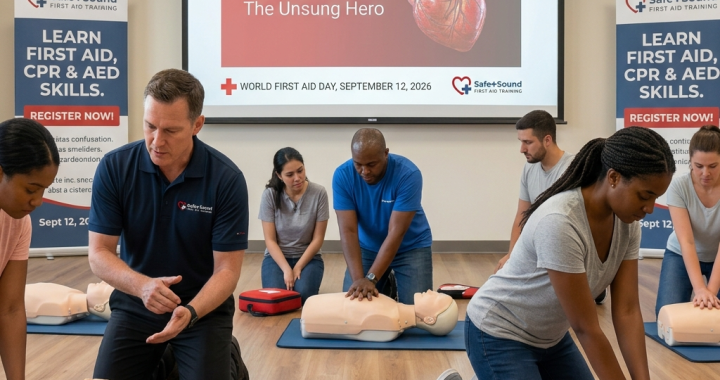
A Safe + Sound First Aid Training instructor and a group of students practicing CPR and AED skills with manikins. A background presentation slide shows the human heart and the title "THE HEART: The Unsung Hero".

The Heart: The Unsung Hero of the Human Body – And How to Save It

Every second of every day, without a moment of hesitation or rest, a muscular pump no larger than your two clasped hands works tirelessly within your chest. It keeps you alive, propels your passions, and powers every step, breath, and thought you take.

September 12, 2026 marks World First Aid Day—a global occasion dedicated to raising awareness about how first aid training can prevent injuries and save lives. This year, at Safe + Sound First Aid Training, we are shining a bright spotlight on the ultimate unsung hero of the human body: the human heart.

We often speak about the heart in poetic terms—as the seat of love, courage, and emotion. But from an anatomical and physiological perspective, the heart is a mechanical masterpiece. It is an extraordinary organ that works behind the scenes, performing mind-boggling feats of engineering every second of our lives. Yet, despite its strength, it can sometimes experience sudden, life-threatening crises. Understanding how the heart works—and knowing how to step in when it stalls—is one of the most vital skills a person can possess.

Did You Know? 7 Mind-Blowing Facts About the Heart

To truly appreciate why the heart deserves the title of the body’s unsung hero, let’s look at some truly incredible facts about this tireless organ:

  1. It Beats Over 100,000 Times a Day. In an average adult, the heart beats around 70 to 100 times per minute. That adds up to roughly 100,000 beats in a single day, over 35 million beats in a year, and well over 2.5 billion beats across an average lifetime—all without taking a single break.
  2. It Pumps Enough Blood to Fill an Olympic Swimming Pool Every minute, your heart pumps about 5 liters (1.3 gallons) of blood. Over 24 hours, that amounts to around 7,500 liters (2,000 gallons) circulating through your body. Across an average lifetime, the heart pumps enough blood to fill more than three Olympic-sized swimming pools!
  3. Your Vascular Network Could Circle the Earth Twice The heart pushes blood through an incredible network of blood vessels—arteries, veins, and capillaries. If you laid all the blood vessels in an adult body end-to-end, they would stretch for approximately 60,000 miles (100,000 km)—long enough to wrap around the Earth twice!
  4. It Has Its Own Independent Electrical System Unlike other muscles that rely entirely on signals from the brain to move, the heart generates its own electrical impulses through a specialized cluster of cells known as the sinoatrial (SA) node—the heart’s natural pacemaker. Because it generates its own electricity, a heart can actually continue to beat outside the human body for a short period, provided it has adequate oxygen.
  5. It Starts Beating Just 4 Weeks After Conception The heart is one of the very first organs to form and function in a human embryo. It begins beating rhythmically around week 4 of pregnancy, long before a person is fully formed, and continues uninterrupted until the end of life.
  6. It Instantly Adjusts to Your Emotions and Activity The heart is finely tuned to your environment. When you exercise, it pumps harder and faster to deliver oxygen to muscles. When you laugh, your blood vessels dilate, boosting cardiovascular flow. Even listening to music can cause your heart rate to sync with the song’s tempo.
  7. Women’s Hearts Beat Slightly Faster Than Men’s On average, a woman’s heart beats about 8 beats per minute faster than a man’s heart. Because women generally have slightly smaller hearts, the organ pumps less blood per beat and compensates by beating faster.

Why the Heart is Truly Amazing

The heart is far more than just a muscle; it is the central power station of human life. Every cell in your body—from your brain down to your toes—depends on the continuous delivery of oxygen and vital nutrients carried by oxygenated blood.

What makes the heart so extraordinary is its sheer resilience and efficiency. This amazing organ operates under variable pressure conditions, adapting dynamically to intense physical exertion, emotional stress, and deep rest. It works while you sleep, while you run, and while you sit reading this blog. It demands very little maintenance compared to the immense mechanical energy it outputs—yet it remains vulnerable to sudden structural or electrical disruptions.

When the Unsung Hero Needs Help: Cardiac Arrest

Because the heart works so quietly in the background, we often take it for granted. However, cardiovascular emergencies can strike anyone, anywhere, at any time—regardless of age or fitness level. One of the most critical medical emergencies is Sudden Cardiac Arrest (SCA).

It is crucial to understand the difference between a heart attack and sudden cardiac arrest:

Heart Attack (A Plumbing Problem): Blood flow to a portion of the heart muscle is blocked. The person is usually conscious and experiencing chest pain or tightness.
Sudden Cardiac Arrest (An Electrical Problem): The heart’s electrical system malfunctions, causing the heart to suddenly stop beating or quiver uselessly (ventricular fibrillation). The victim collapses, becomes unresponsive, and stops breathing normally.
When cardiac arrest occurs, blood stops flowing to the brain and vital organs. Brain injury begins in as little as 4 to 6 minutes, and death can occur within 10 minutes without intervention.

The Power of Bystander Intervention

Over 80% of out-of-hospital cardiac arrests happen at home or in public places. Survival rates decrease by 7% to 10% for every minute that passes without CPR and defibrillation. However, immediate high-quality CPR delivered by a bystander can double or triple a victim’s chances of survival.

Call to Action: Empower Yourself This World First Aid Day

The heart spends a lifetime taking care of you—it’s time you learned how to take care of someone else’s heart when it stops working.

Performing CPR acts as a manual pump, keeping oxygenated blood flowing to the brain until emergency responders arrive. Using an Automated External Defibrillator (AED) provides the electrical reset button needed to shock the heart back into a normal rhythm.

You don’t need a medical degree to save a life—you just need hands-on training and the confidence to act when every second counts.

Be the difference between life and death.

👉 Register for a Red Cross First Aid course with Safe + Sound Today and learn to save a life.

Diverse children and adults learn life-saving skills at various first aid training stations. In the background, a large promotional banner with text celebrates World First Aid Day 2026. A large hand in the foreground holds two smartphones; the screens display digital first aid resources, including a CPR step-by-step list and the Red Cross First Aid App with icons for common emergencies

World First Aid Day 2026

Empowering Every Hero: Celebrating World First Aid Day 2026 and How You Can Save a Life

Every year on the second Saturday of September, communities around the globe unite to highlight a set of skills that can bridge the gap between tragedy and survival: first aid. On Saturday, September 12, 2026, World First Aid Day reminds us that medical emergencies rarely announce themselves in advance.

Whether it is a sudden cardiac arrest at a local hockey rink, a severe allergic reaction at a family dinner, or a sudden fall in the backyard, the first person on the scene is rarely a doctor or paramedic. More often than not, it is an ordinary person—a parent, coworker, neighbour, or passerby. Having the knowledge, confidence, and practical skills to step forward in those critical first few minutes can mean the difference between life and death.

This article covers the history of World First Aid Day, the essential role of the Canadian Red Cross, and the simple, proactive steps you can take to protect your loved ones and community.

The History and Mission of World First Aid Day

World First Aid Day was officially established in 2000 by the International Federation of Red Cross and Red Crescent Societies (IFRC). However, the foundational philosophy of first aid extends back to 1859 on the battlefield of Solferino, Italy. Witnessing thousands of wounded soldiers left without care, Henry Dunant organized local citizens to treat the injured regardless of which side they fought on. His compassionate action sparked the birth of the global Red Cross movement.

Since 2000, World First Aid Day has been celebrated annually to advocate for accessible first aid education for everyone, everywhere. The objective is simple yet profound: to raise awareness of how everyday first aid skills can prevent injuries, save lives, and build resilient, safety-conscious communities during both daily incidents and large-scale crises.

The Canadian Red Cross: Leading First Aid Education Across Canada

In Canada, the Canadian Red Cross stands at the forefront of emergency response and safety training. As a trusted leader in health and safety, the organization continuously develops evidence-based, practical training programs grounded in the latest resuscitation science.

Research shows that a vast majority of medical emergencies happen at home or in public spaces where family and friends are present. Yet many people feel unprepared or hesitant to act during a crisis. The Canadian Red Cross works to dismantle that hesitation by establishing high training standards, developing accessible learning materials, and supporting a national network of dedicated Training Partners. Through these efforts, millions of Canadians have gained the skills and confidence needed to act decisively when every second counts.

What You Can Do to Make a Difference

Celebrating World First Aid Day isn’t just about recognizing the importance of first aid—it is about taking concrete action. Here are three impactful steps you can take today to keep your family, workplace and community safer:

1. Take a First Aid and CPR Course
Nothing replaces hands-on practice. Enrolling in a certified First Aid and CPR/AED course equips you with vital life-saving techniques. You will learn how to perform high-quality chest compressions, operate an Automated External Defibrillator (AED), manage severe bleeding, assist a choking victim, and address medical emergencies like strokes and heart attacks. Beyond learning procedures, hands-on training builds muscle memory and composure, helping you stay calm under pressure.

2. Download the Canadian Red Cross First Aid App
Technology puts life-saving guidance right in the palm of your hand. The free Canadian Red Cross First Aid App provides instant, offline access to simple, step-by-step instructions for common emergencies. It offers safety advice, and quick reference guides for everything from burns to severe allergic reactions. Having it pre-loaded on your smartphone ensures you can always access expert guidance, even without cell service.

3. Prepare Youth with Babysitting and Home Alone Classes
Safety education is one of the most empowering gifts you can give children and pre-teens. Enrolling your child in a Canadian Red Cross youth safety course fosters independence, confidence, and responsibility:

Home Alone Class: Designed for younger children preparing to stay on their own for short periods. Kids learn essential safety rules, basic first aid (such as treating minor cuts and burns), fire safety, and how to handle unexpected situations or callers.
Babysitting Course: Geared toward youth aged 11 and up who want to care for younger siblings or start babysitting. Participants learn child care techniques, safety protocols, leadership skills, and basic first aid tailored specifically for infants and children.

Spotlight on Safe + Sound First Aid Training

For residents in Metro Vancouver and the Tri-Cities (Coquitlam, Port Coquitlam, and Port Moody), Safe + Sound First Aid Training is your trusted local hub for first aid and safety education.

Safe + Sound has been a proud Red Cross Training Partner since 1999, bringing 27 years of experience, expertise, and engaging instruction to the community. We offer comprehensive, hands-on First Aid and CPR/AED training tailored for workplace requirements, students, childcare providers, and individuals who want to be prepared.

In addition to in-person first aid training and youth safety programs like virtual Babysitting and online Home Alone classes, Safe + Sound offers hundreds of online safety training classes for adults. These flexible, self-paced online courses cover workplace compliance, occupational health and safety, and specialized industry safety—making it easy to upgrade your certifications from the comfort of home or work.

To explore our course offerings, view upcoming schedules, or register online, visit our website at www.learnfirstaid.ca.

Take Action This World First Aid Day!

Don’t wait for an emergency to realize you need training or supplies. Take action today to prepare your family and your workplace:

  1. Register for a Course: Visit www.learnfirstaid.ca to sign up for an upcoming First Aid and CPR class, or register your child for a virtual Babysitting or Home Alone course.
  2. Inspect and Update Your First Aid Kit: Check your home, vehicle, and workplace first aid kits. Safely dispose of expired medications and restock essential supplies like sterile gauze, adhesive bandages, antiseptic wipes, nitrile gloves, and CPR masks.
  3. Review Emergency Preparedness Supplies: Stock your home emergency kit with fresh drinking water, non-perishable food, flashlights, fresh batteries, and a hand-crank radio.
  4. Download the App: Install the official Canadian Red Cross First Aid App on your family’s devices today. First aid is an act of humanity, responsibility, and empowerment.

By investing a little time to learn these vital skills this World First Aid Day 2026, you become a critical link in the chain of survival—ready to help when needed. World First Aid Day is the perfect time to refresh your first aid skills or learn them for the first time—because being prepared starts before an emergency happens.
@redcrosscanada #WorldFirstAidDay