Every second of every day, without a moment of hesitation or rest, a muscular pump no larger than your two clasped hands works tirelessly within your chest. It keeps you alive, propels your passions, and powers every step, breath, and thought you take.
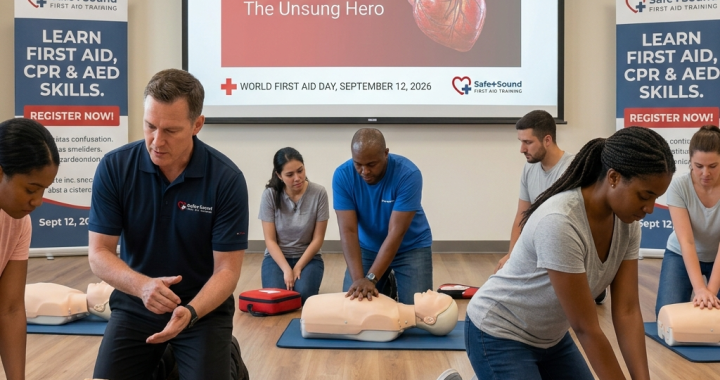
September 12, 2026 marks World First Aid Day—a global occasion dedicated to raising awareness about how first aid training can prevent injuries and save lives. This year, at Safe + Sound First Aid Training, we are shining a bright spotlight on the ultimate unsung hero of the human body: the human heart.
We often speak about the heart in poetic terms—as the seat of love, courage, and emotion. But from an anatomical and physiological perspective, the heart is a mechanical masterpiece. It is an extraordinary organ that works behind the scenes, performing mind-boggling feats of engineering every second of our lives. Yet, despite its strength, it can sometimes experience sudden, life-threatening crises. Understanding how the heart works—and knowing how to step in when it stalls—is one of the most vital skills a person can possess.
Did You Know? 7 Mind-Blowing Facts About the Heart
To truly appreciate why the heart deserves the title of the body’s unsung hero, let’s look at some truly incredible facts about this tireless organ:
- It Beats Over 100,000 Times a Day. In an average adult, the heart beats around 70 to 100 times per minute. That adds up to roughly 100,000 beats in a single day, over 35 million beats in a year, and well over 2.5 billion beats across an average lifetime—all without taking a single break.
- It Pumps Enough Blood to Fill an Olympic Swimming Pool Every minute, your heart pumps about 5 liters (1.3 gallons) of blood. Over 24 hours, that amounts to around 7,500 liters (2,000 gallons) circulating through your body. Across an average lifetime, the heart pumps enough blood to fill more than three Olympic-sized swimming pools!
- Your Vascular Network Could Circle the Earth Twice The heart pushes blood through an incredible network of blood vessels—arteries, veins, and capillaries. If you laid all the blood vessels in an adult body end-to-end, they would stretch for approximately 60,000 miles (100,000 km)—long enough to wrap around the Earth twice!
- It Has Its Own Independent Electrical System Unlike other muscles that rely entirely on signals from the brain to move, the heart generates its own electrical impulses through a specialized cluster of cells known as the sinoatrial (SA) node—the heart’s natural pacemaker. Because it generates its own electricity, a heart can actually continue to beat outside the human body for a short period, provided it has adequate oxygen.
- It Starts Beating Just 4 Weeks After Conception The heart is one of the very first organs to form and function in a human embryo. It begins beating rhythmically around week 4 of pregnancy, long before a person is fully formed, and continues uninterrupted until the end of life.
- It Instantly Adjusts to Your Emotions and Activity The heart is finely tuned to your environment. When you exercise, it pumps harder and faster to deliver oxygen to muscles. When you laugh, your blood vessels dilate, boosting cardiovascular flow. Even listening to music can cause your heart rate to sync with the song’s tempo.
- Women’s Hearts Beat Slightly Faster Than Men’s On average, a woman’s heart beats about 8 beats per minute faster than a man’s heart. Because women generally have slightly smaller hearts, the organ pumps less blood per beat and compensates by beating faster.
Why the Heart is Truly Amazing
The heart is far more than just a muscle; it is the central power station of human life. Every cell in your body—from your brain down to your toes—depends on the continuous delivery of oxygen and vital nutrients carried by oxygenated blood.
What makes the heart so extraordinary is its sheer resilience and efficiency. This amazing organ operates under variable pressure conditions, adapting dynamically to intense physical exertion, emotional stress, and deep rest. It works while you sleep, while you run, and while you sit reading this blog. It demands very little maintenance compared to the immense mechanical energy it outputs—yet it remains vulnerable to sudden structural or electrical disruptions.
When the Unsung Hero Needs Help: Cardiac Arrest
Because the heart works so quietly in the background, we often take it for granted. However, cardiovascular emergencies can strike anyone, anywhere, at any time—regardless of age or fitness level. One of the most critical medical emergencies is Sudden Cardiac Arrest (SCA).
It is crucial to understand the difference between a heart attack and sudden cardiac arrest:
Heart Attack (A Plumbing Problem): Blood flow to a portion of the heart muscle is blocked. The person is usually conscious and experiencing chest pain or tightness.
Sudden Cardiac Arrest (An Electrical Problem): The heart’s electrical system malfunctions, causing the heart to suddenly stop beating or quiver uselessly (ventricular fibrillation). The victim collapses, becomes unresponsive, and stops breathing normally.
When cardiac arrest occurs, blood stops flowing to the brain and vital organs. Brain injury begins in as little as 4 to 6 minutes, and death can occur within 10 minutes without intervention.
The Power of Bystander Intervention
Over 80% of out-of-hospital cardiac arrests happen at home or in public places. Survival rates decrease by 7% to 10% for every minute that passes without CPR and defibrillation. However, immediate high-quality CPR delivered by a bystander can double or triple a victim’s chances of survival.
Call to Action: Empower Yourself This World First Aid Day
The heart spends a lifetime taking care of you—it’s time you learned how to take care of someone else’s heart when it stops working.
Performing CPR acts as a manual pump, keeping oxygenated blood flowing to the brain until emergency responders arrive. Using an Automated External Defibrillator (AED) provides the electrical reset button needed to shock the heart back into a normal rhythm.
You don’t need a medical degree to save a life—you just need hands-on training and the confidence to act when every second counts.
Be the difference between life and death.
👉 Register for a Red Cross First Aid course with Safe + Sound Today and learn to save a life.