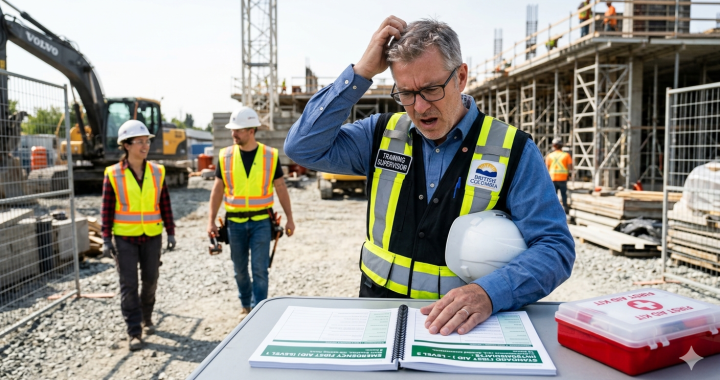
The following post will answer the most common questions regarding Basic First Aid and Intermediate First Aid.
First aid training and certification in British Columbia have undergone significant changes recently. With new terminology introduced by the Canadian Red Cross and updated alignments with WorkSafeBC (OFA) and Canadian Standards Association (CSA), it is no surprise that individuals and employers are feeling a bit confused.
At Safe + Sound First Aid Training, our goal is to make life-saving skills accessible and clear. Whether you are a construction supervisor, a daycare worker, or a concerned parent, choosing the right course is the first step toward safety.
Decoding the Names
The biggest hurdle for most people right now is the terminology. You might see three different names for what is essentially the same level of certification.
1. Basic First Aid (formerly “Emergency First Aid”)
Historically known as Emergency First Aid or Occupational First Aid (OFA) Level 1, this level is now officially referred to as Basic First Aid under the new national standards and by WorkSafeBC.
The Names: Basic First Aid = OFA Level 1 = Emergency First Aid
2. Intermediate First Aid (formerly “Standard First Aid”)
Traditionally called Standard First Aid, this course is now known as Intermediate First Aid. One of the most significant recent changes is that WorkSafeBC now recognizes this level as equivalent to Occupational First Aid (OFA) Level 2.
The Names: Intermediate First Aid = OFA Level 2 = Standard First Aid.
Basic First Aid vs. Intermediate First Aid – What’s the Difference?
While both courses cover life-saving essentials like CPR and AED (Automated External Defibrillator) use, the primary differences lie in duration, depth, and regulatory requirements.
Basic First Aid
This course includes 8 hours of training and is designed for people who need a general knowledge of first aid for a low-risk work environment or personal interest. It can be offered as a one-day, in-person session or a blended course, where participants complete a short online theory component before attending a 5-6 hour in-person, practical skills training session.
Focus: Life-threatening emergencies.
Key Topics: CPR, AED, choking, severe bleeding, wound care, and medical emergencies (heart attacks/strokes).
Best For: Small offices, retail workers, and those who need to meet the minimum WorkSafeBC requirements for a basic workplace.
Intermediate First Aid
This is a comprehensive 16 hour program. It covers everything in the Basic course but goes into much greater detail regarding injuries and illnesses and includes additional topics. Standard First Aid can be offered as a two-day, in-person session or a blended course where participants complete an online theory component before attending an 8-hour in-person, practical skills training session.
Focus: Full-body assessment and management of a wide variety of injuries.
Key Topics: Everything in Basic First Aid, plus head/spinal injuries, bone/joint/muscle injuries, poisons, environmental emergencies (heat/cold), and more in-depth secondary surveys.
Best For: High-risk industries (construction, forestry, manufacturing), schools, daycare workers (specifically the 16-hour version), and large workplaces that are distant from a hospital.
How to Decide Which First Aid Course You Need
For the Individual
If you are taking a course for your own peace of mind, Basic First Aid is a great starting point. However, if you have children or spend a lot of time outdoors, we highly recommend Intermediate First Aid because it covers fractures, sprains, and environmental issues common in active lifestyles.
For the Employer
Your choice is dictated by WorkSafeBC (Occupational Health and Safety) Regulations. To determine which level you need, you must consider:
- The hazard level of your workplace (Low vs. High).
- The number of employees on a shift.
- The travel time to the nearest hospital.
- Tip: Generally, if you have a larger crew or work in a higher-risk setting, WorkSafeBC will require at least one person with Intermediate (OFA 2) certification on-site.
Blended First Aid classes vs. traditional, in-person first aid. What’s the difference?
The main difference between these courses lies in how you spend your time, not the certification you receive. Whether you choose “Blended” or “Traditional,” the curriculum and the resulting certificate are identical, and workplace safety regulators like WorkSafeBC or WSIB recognize both.
Here is a breakdown of the differences to help you choose the right format.
1. Structural Comparison
The “Blended” format splits the course into two halves: digital theory and in-person practice. The “Traditional” format is fully immersive in a classroom setting.
| Feature | Blended First Aid | Traditional First Aid |
| Theory | Completed online at your own pace (videos, quizzes, interactive slides). | Taught in-person via instructor lectures and textbooks. |
| Skills | In-person session is 100% focused on hands-on practice (CPR, AED, bandages). | Skills are woven into the full-day or multi-day classroom session. |
| Time in Class | Significantly reduced (usually half the time). | Full duration (1 day for Emergency; 2 days for Standard). |
| Prerequisites | Must finish online modules before the class date. | No pre-work required; just show up. |
2. Time Commitment Breakdown
Because the theory is moved online, the “Blended” option saves you substantial “seat time” in a physical classroom.
Basic First Aid
Traditional: Typically 8 hours in one day.
Blended: Approx. 4 hours online + 4–6 hours in-person.
Intermediate First Aid
Traditional: Typically 16 hours over two full days.
Blended: Approx. 8 hours online + one full day (8 hours) in-person.
Tip: If you choose the Blended option, ensure you complete your online component at least 24-48 hours before your in-person session. Red Cross instructors will not allow you to participate in the practical session without proof that you have finished the digital portion.
Frequently Asked Questions (FAQ) about First Aid Training
To help you figure out which course is best for you, we’ve compiled the most common questions our instructors receive at Safe + Sound.
Q: Is Basic First Aid equivalent to the old OFA Level 1 course?
A: Yes. In British Columbia, WorkSafeBC recognizes the Canadian Red Cross Basic First Aid course as an OFA Level 1 equivalent. If your employer asks for OFA 1, the Basic First Aid course will satisfy that requirement.
Q: I’ve been told I need “Standard First Aid.” Is that now called “Intermediate”?
A: Correct. The Canadian Red Cross updated its Standard First Aid course to Intermediate First Aid to align with new national CSA (Canadian Standards Association) classifications. Intermediate First Aid and Standard are the same level of training.
Q: Does Intermediate First Aid count as OFA Level 2?
A: Yes, it does now! This is a major update. Previously, OFA Level 2 was a separate, workplace-specific course. Now, WorkSafe BC recognizes the Intermediate First Aid course as the equivalent of OFA Level 2.
Q: Which course do I need if I’m a childcare worker or Early Childhood Education (ECE) student?
A: In BC, the Child Care Licensing Regulation typically requires a first aid certificate that includes CPR and is at least 8 hours long. Many employers and licensing officers prefer or require the Emergency Child Care First Aid or Intermediate First Aid courses because they provide more detail on pediatric emergencies.
Q: How long are these certifications valid?
A: Both Basic First Aid and Intermediate First Aid certifications are valid for three years. After three years, you must take a recertification course or repeat the full course to remain compliant.
Q: Can I take these courses online?
A: Safe + Sound offers “Blended Learning” options. This means you complete the theoretical portion online at your own pace and then attend a shorter in-person session for hands-on skills, like CPR and bandaging. You cannot get a WorkSafeBC-equivalent certification through a 100% online course; a practical component is mandatory.
Q: What is the difference in CPR levels (Level A vs. Level C)?
A: CPR Level A covers adults only. CPR Level C covers adults, children, and infants.
Most of our workplace courses automatically include CPR Level C to ensure you are prepared for any situation.
Why Train with Safe + Sound?
Choosing a first aid provider is about more than just checking a box. At Safe + Sound First Aid Training, we focus on confidence. We don’t want you to just “pass” the course; we want to empower you with the skills and confidence to step in and act quickly and effectively when an emergency happens.
Our instructors are experienced professionals who bring real-world scenarios into the classroom, making the time fly by. Whether you are coming to our Coquitlam facility or we are bringing the training to your office, you can expect high-quality equipment and engaging instruction.
Ready to book your spot and learn to save a life?
View our Basic First Aid Schedule
View our Intermediate First Aid Schedule
If you are an employer and are still unsure about your WorkSafeBC requirements, or if you’d like to get your staff trained in first aid, please contact us.
Don’t wait for an accident to happen. Get trained. Get certified. Be the difference.