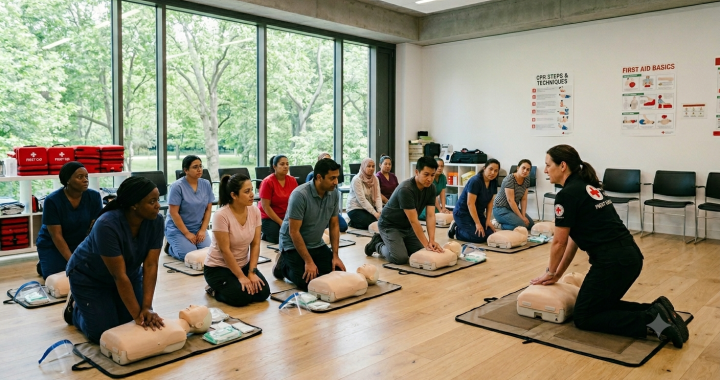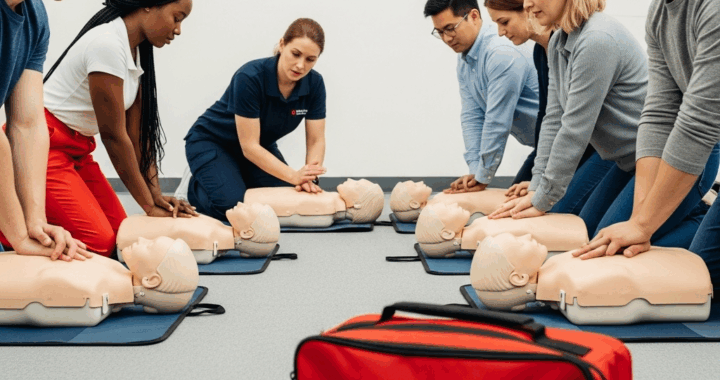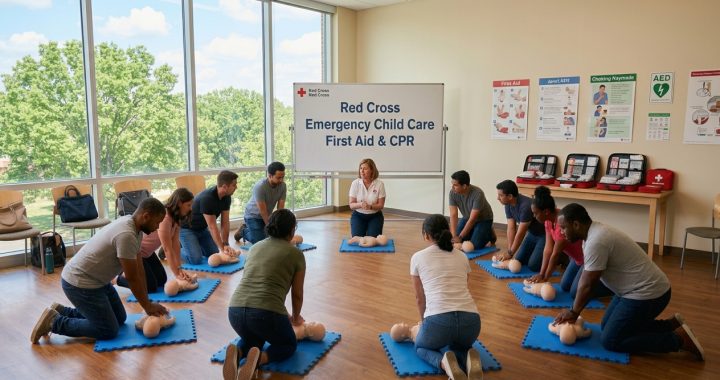
Students in a first aid and CPR class, practising CPR using child manikins. In the foreground is a red first aid kit bag with the words Safe + Sound First Aid Training learnfirstaid.ca

First Aid Training for Child Care Workers

The Ultimate Guide to First Aid & CPR Training for Child Care Workers in BC: Protecting Our Little Ones

As a childcare worker or an Early Childhood Education (ECE) student in British Columbia, you hold one of the most vital and trusted roles in our society: caring for our most vulnerable citizens – our children. Every day, you create nurturing environments where young minds grow, play, and explore. But what happens when the unexpected strikes? When a child chokes, falls, or experiences a sudden medical emergency?

In those critical moments, your swift, confident, and correct actions can mean the difference between a minor incident and a tragic outcome. This isn’t just about good practice; it’s about a profound responsibility, regulated by the highest standards, and supported by essential training.

This comprehensive guide will walk you through everything you need to know about first aid and CPR training for childcare professionals in BC. We’ll explore the specific legal requirements, answer your most pressing questions, and explain why choosing the right training provider – one deeply committed to excellence and real-world preparedness – is the best decision you can make for the children in your care, your career, and your peace of mind.

The Heartbeat of Childcare: Why First Aid & CPR is Non-Negotiable

Imagine a bustling playroom, filled with laughter and the joyful sounds of children at play. Suddenly, a moment of silence. A small child has put something in their mouth and is now unable to breathe. Or perhaps, during naptime, an infant becomes unresponsive. These are scenarios no childcare professional ever wants to face, yet they underscore the constant, unpredictable nature of emergencies involving young children.

For childcare workers and ECE students, first aid and CPR training isn’t merely a certification; it’s a foundational pillar of their professional competence. It’s the assurance that when an emergency arises, you are equipped not just with good intentions, but with the precise skills needed to prevent a crisis from escalating.

Why Child Care Workers Must be confident in their first aid skills:

Protecting Vulnerable Lives: Children, especially infants and toddlers, are more susceptible to certain emergencies (like choking on small objects or specific allergic reactions). Their bodies respond differently to injury and illness than adults. Specialized training ensures you understand these nuances.

Legal and Ethical Responsibility: Your role comes with a significant duty of care. Being trained in first aid and CPR isn’t just an ethical imperative; it’s a legal requirement to ensure the safety and well-being of every child entrusted to you.

Building Parental Trust: Parents entrust their most precious treasures to your care. Knowing you are fully certified and capable of handling emergencies instills immense trust and confidence in your facility or program. It’s a key factor in their decision-making process.

Confidence in Crisis: Emergencies are stressful. Having up-to-date, hands-on training empowers you to remain calm, assess the situation accurately, and administer appropriate care, potentially saving a life before paramedics arrive.

Early Intervention Saves Lives: The first few minutes of an emergency are often the most critical. Immediate and correct first aid can stabilize a child, prevent further injury, and provide vital support until professional medical help can take over. This is especially true for cardiac or breathing emergencies, where every second counts.

Preventative Awareness: Beyond immediate response, quality first aid training also enhances your awareness of potential hazards, helping you implement preventative measures in your childcare environment to minimize risks.

Ultimately, first aid and CPR training transforms you from a caring individual into a capable life-saver, ready to face the unexpected with skill and courage.

Navigating the Law: BC Child Care Licensing Act & Your First Aid Requirements (Schedule C)

In British Columbia, the safety standards for licensed childcare facilities are clear and legally binding. For childcare workers and ECE students, understanding and complying with these regulations is paramount for maintaining your professional credentials and ensuring your facility meets licensing standards. The specific requirements for first aid are outlined in Schedule C of the BC Child Care Licensing Act.

Let’s break down the critical details from Schedule C to ensure you’re fully compliant:

Schedule C Excerpt & Explanation

Course Requirements:

For the purposes of section 23 (1) [first aid], the employee must hold a valid first aid and CPR certificate from a course that meets all of the following requirements:

(a) The course must offer at least 8 hours of instruction, at least 3.5 hours of which must be delivered in person;
This explicitly states that while a portion of the course can be delivered online or through self-study, a significant amount – at least 3.5 hours – must be hands-on, in-person instruction. This hybrid model ensures you get critical practical experience. The total instruction time must be a minimum of 8 hours.

(b) The course instructor must have the qualifications necessary to train employees in the skills referred to in section 2 of this Schedule;
This ensures that your instructor isn’t just any first aid provider, but someone specifically qualified to teach first aid skills relevant to children and infants, as detailed later in Schedule C. Reputable organizations like the Canadian Red Cross ensure their Training Partners and instructors meet these high standards.

(c) The first aid certificate

(i) is issued only after the employee has successfully completed an examination that includes demonstration and evaluation of the skills relevant to the matters described in section 2 of this Schedule.

(ii) is signed by the instructor or is verifiable using a system established and maintained by the issuer of the certificate.

(iii) includes the employee’s name, the level of first aid training achieved by the employee and the name of the agency that provided the training.

(iv) expires no more than 3 years from the date of issue

(v) is not renewable unless the holder, before the expiry date, participates in at least 8 hours of further instruction, at least 3.5 hours of which must be delivered in person, followed by an examination that includes demonstration and evaluation of the skills relevant to the matters described in section 2 of this Schedule.

This section defines what constitutes a valid certificate. It must be:

  • Issued only after successful completion of an examination that includes practical demonstration of skills. This means you can’t just pass a quiz; you must show you can perform the life-saving techniques.
  • Signed by the instructor or verifiable through the issuing agency’s system.
  • Clearly state your name, the level of training, and the training agency.
  • Valid for a maximum of 3 years.
  • Renewable only if you participate in another 8-hour course (with 3.5 hours in-person) and pass an examination before your current certificate expires. This highlights the importance of timely re-certification.

 Required First Aid Course Content for Children and Infants:

A first aid course is not sufficient for the purposes of section 23 [first aid] unless the course provides instruction in, and requires successful completion of, an examination that includes demonstration and evaluation of skills relevant to all of the following matters in respect of children and infants:

(a) management of an emergency scene;

(b) assessment of a patient;

(c) fainting and unconsciousness;

(d) cardiopulmonary resuscitation skills recognized by the agencies referred to in section 1 (b) of this Schedule as “(CPR) Level B” or a program that is equivalent;

(e) shock;

(f) choking;

(g) wounds and severe bleeding;

(h) insect, animal and human bites;

(i) eye injuries;

(j) spinal and head injuries;

(k) dental emergencies;

(l) fractures of the upper and lower limbs, including bone and joint injuries;

(m) cardiovascular emergencies, including the use of automated external defibrillators;

(n) burns;

(o) electric shock;

(p) poisoning;

(q) environmental injuries, including exposure to heat or cold;

(r) common medical conditions, including diabetes, epilepsy, convulsions and allergic reactions;

(s) breathing and airway emergencies.
This detailed list specifies the exact topics you must be trained in and tested on, specifically with regard to children and infants. It covers a wide range of emergencies, from managing a scene to specific injuries and medical conditions, and explicitly states the requirement for CPR Level B or an equivalent program, tailored for pediatric care.

Understanding these requirements from Schedule C is crucial for compliance and, more importantly, for ensuring you possess the comprehensive skills necessary to protect the children in your care.

Your Questions, Answered: FAQs About First Aid Training for Child Care Workers

Navigating the world of first aid certification can sometimes feel complex. Here are some of the most frequently asked questions by childcare workers and ECE students, along with clear answers to guide you:

Q1: Which first aid course do I need to be licensed in BC childcare?

A1: You typically need a course that specifically meets the requirements of BC Child Care Licensing Act, Schedule C. The Canadian Red Cross Emergency Child Care First Aid & CPR Level B course is specifically designed to meet these requirements. Register for a class in Coquitlam here.

Q2: How long is my first aid certificate valid for?

A2: According to Schedule C, your first aid certificate should expire no more than 3 years from the date of issue. Canadian Red Cross first aid certificates are valid for three years from the date of issue.

Q3: Can I complete all my first aid training online?

A3: No. Schedule C explicitly states that at least 3.5 hours of instruction must be delivered in person, along with a practical examination to demonstrate skills. While some courses offer an online component, the hands-on portion is mandatory for compliance.

Q4: What’s the difference between Standard First Aid and Emergency Child Care First Aid?

A4: While Standard First Aid covers a broad range of emergencies for adults, children, and infants, Emergency Child Care First Aid (ECCFA) is specifically tailored to the unique first aid and CPR needs of children and infants. It covers all the specific topics listed in Schedule C in depth, making it the most suitable and often required course for childcare professionals.

Q5: Do I need CPR Level B or C?

A5: Schedule C specifically requires CPR Level B or an equivalent program, which focuses on CPR for infants and children. While Level C includes adult CPR, Level B is the minimum required for childcare purposes. If you work with children over the age of eight years as well as with younger children and babies, it’s best to take a Standard First Aid & CPR level C class.

Q6: What happens if my first aid certificate expires?

A6: If your certificate expires, you are no longer considered compliant with the BC Child Care Licensing Act’s first aid requirements. To renew, Schedule C states you must participate in another full 8-hour course (with 3.5 hours in-person) and pass the examination before your current certificate expires. If it has expired, you will need to retake the full course. It’s crucial to recertify on time!

Q7: How often must I renew my certification?

A7: Every 3 years as per Schedule C. It’s advisable to book your re-certification course well in advance of your expiry date.

Q8: What kind of examination is required for certification? A8: The examination must include both demonstration and evaluation of skills. This means you’ll perform practical first aid and CPR techniques, which will be assessed by your instructor. You will also be required to complete a written, multiple choice test.

Q9: Can I get my certificate immediately after completing the course?

A9: Reputable training agencies will issue a verifiable certificate soon after successful completion. The official certificate will usually be delivered electronically shortly after the class.

Q:10: How can I check that the employees in my child care centre have valid first aid certificates?

A10: To check if a Red Cross first aid certificate is valid, click here and follow the instructions from Red Cross.


Why Safe + Sound First Aid Training is Your Trusted Partner in Safety

When it comes to something as critical as child safety and your professional compliance, choosing the right first aid training provider is paramount. Safe + Sound First Aid Training stands out as an excellent choice for childcare workers, ECE students, adult babysitters, parents, and grandparents in the Tri-Cities and Metro Vancouver areas who need first aid training.

Our commitment to excellence is deeply rooted in a powerful personal experience: Our founder’s journey began with a terrifying moment when a friend’s baby choked and nearly died. Being able to save that precious life ignited a profound, lifelong passion to empower others with those same life-saving skills. This isn’t just a business for us; it’s a mission to build safer, happier communities.

Here’s why Safe + Sound First Aid Training is the preferred choice for your essential certifications:

Unwavering Credibility & Experience

Proud Canadian Red Cross Training Partner: This ensures our courses meet the highest national standards and are recognized by regulatory bodies, including compliance with BC Child Care Licensing Act requirements.

Established since 1999: We bring over 25 years of industry experience to every class. This long-standing history means we understand the evolving needs of our clients and the nuances of effective training.

Proven Impact: We’ve successfully trained over 50,000 satisfied clients in first aid and CPR, directly contributing to the saving of countless lives.

Award-Winning Excellence: We were the first Canadian recipient of the Red Cross Partners in Humanity Citation, a testament to our commitment to humanitarian principles and exceptional training delivery.

A+ BBB Rating: Our top rating with the Better Business Bureau reflects our dedication to customer satisfaction and ethical business practices.
Tailored Programs for Child Care Professionals:

Safe + Sound offers the Emergency Child Care First Aid & CPR Level B course, specifically designed to fulfill all the requirements outlined in the BC Child Care Licensing Act, Schedule C. This means you’re getting precisely the training you need for your role. The Red Cross curriculum we use thoroughly covers all the necessary topics for children and infants, from scene management and patient assessment to specific conditions like choking, allergic reactions, fractures, and CPR for infants and children, ensuring you meet the detailed requirements of Section 2 of Schedule C.
You can easily register for Emergency Child Care First Aid classes in Coquitlam here.

Exceptional Instruction & Hands-On Learning:

Our instructors are highly experienced, qualified, and passionate about teaching. They make learning engaging and ensure you get the critical hands-on practice required by Schedule C.
We focus on ensuring you leave not just with a certificate, but with the confidence and practical skills to apply your knowledge effectively in real-life emergencies.

Flexible Training Options for Every Need

Public Classes: Conveniently offered at our dedicated Coquitlam classroom, making it accessible for individuals in the Tri-Cities (Coquitlam, Port Coquitlam, Port Moody) and surrounding Metro Vancouver areas. The venue we use has plenty of free parking and easy access to bus and SkyTrain routes.

Private Group Training: Ideal for childcare centres, schools, and organizations. We can deliver customized training either at our Coquitlam classroom or onsite at your facility if you have a suitable training room. Learn more about Private Group Training here.

Extensive Online Offerings: While licensing requires in-person components, we also provide a wide variety of online safety and soft skills courses, complementing your core first aid training. For youth, we offer valuable virtual Red Cross Babysitting and Home Alone online courses, perfect for future caregivers.

Serving a Broad Community

Our in-person classes cover a wide service area, including Coquitlam, Port Coquitlam, Port Moody, Vancouver, Burnaby, New Westminster,  Pitt Meadows, Maple Ridge, Surrey, Langley, and Richmond.
Our virtual and self-directed online courses, including youth safety classes, are accessible throughout Canada, extending our reach beyond BC.

Whether you’re an ECE student beginning your career, an experienced childcare professional, an adult babysitter, or a parent or grandparent wanting to be prepared, Safe + Sound First Aid Training provides the right course for you. At Safe + Sound, we don’t just provide certifications; we build confidence, instill knowledge, and empower communities to be prepared. We understand the profound trust placed in childcare professionals, and we are dedicated to ensuring you are always ready for the unexpected.

Your Next Step Towards a Safer Tomorrow

Your role in childcare is invaluable, and being fully prepared for any emergency demonstrates your professionalism and commitment. Choosing Safe + Sound First Aid Training means selecting a partner with extensive experience, unwavering credibility, and a personal commitment to saving lives.

Don’t wait for an emergency to realize the importance of proper training. Fulfill your licensing requirements, enhance your skills, and gain the confidence to protect the little ones in your care. Ready to take the next step towards a safer, more confident future?

Register for an Emergency Child Care First Aid class in Coquitlam or Contact Safe + Sound First Aid Training today to discuss your training needs, request a quote for private group training or explore our course offerings. We look forward to meeting you and your team soon!

Young child playing with lego on living room floor.

Home Alone Online Training Canada

Is Your Child Ready to Stay Home Alone?

How can we help prepare children to stay home alone, and what signs show they are ready?

Over 26 years of providing Red Cross first aid, babysitting, and home-alone classes, parents and caregivers have asked us many questions about leaving their children at home alone. This complex and contentious issue involves many considerations. Parents and caregivers are justified in taking the issue seriously. Parenting is a challenging and often grey area. There are many cases where parents have been accused of neglecting their children by leaving them home alone. Some cases are more clear-cut than others. The following article will discuss how to assess whether your child is ready to stay at home alone and the benefits of Home Alone Online Training.

Home Alone Stories in the News

In April 2024, in Houston, a 29-year-old mother was arrested and charged with child abandonment when she left her six and eight-year-olds alone at home while she left the country to go on a cruise. In another case, an Iowa state supreme court ruled that a mother did not commit the crime of child endangerment when she left five children ages 5 to 12 home alone while she shopped for groceries at Walmart with her baby. The court argued, “No parent can shield a child from all risks, and no evidence shows that leaving the kids home was any riskier than driving them to Walmart.”

What could go wrong when a child is home alone?

Below are some of the most common concerns parents mention when considering whether their child is ready to stay home alone. How would they handle the following situations:

  • They start choking on a snack
  • There is a power outage
  • They cut themselves and are bleeding
  • The stove catches fire
  • Someone keeps ringing the doorbell or knocking at the door
  • A pipe bursts in the house
  • If you’re unsure whether your child can handle the above, take the necessary steps to prepare them. These include discussion, role play, and training courses like Home Alone, Babysitting, or First Aid.

What is the minimum age for leaving children home alone?

The age at which a child can be safely left at home alone is the most frequently asked question by parents about home alone safety. The law varies between and within countries. Parents often wonder why, in many areas, there is no explicit minimum age for children to be allowed to stay at home alone or babysit. Not all children mature at the same speed, and age is only one factor to consider when assessing a child’s readiness.

Individual differences in temperament, capacity, maturity, access to emergency services, and willingness are also things to consider. For example, a fourteen-year-old may be keen to stay home alone; however, challenges like visual impairment or mobility issues may make it risky.

Check your local community’s child protection services for guidelines or laws regarding the suggested minimum age to leave a child home alone. Caregivers should never force a child to stay home alone if they are not ready. The safety and well-being of the child should always be the top priority.

How can I tell if my child is ready to stay home alone?

Every child matures differently, but some signs indicate your child is ready to stay home unsupervised for short periods. These signs will help parents and guardians gauge their child’s readiness.

The child:

  • Is at least ten years old.
  • Follows family rules and instructions.
  • Knows their full name, phone number, address, and main street intersections.
  • Knows the number for Emergency Medical Services and understands when to contact them.
  • Feels confident to stay home alone.
  • Doesn’t panic when the unexpected arises.
  • Has training in basic first aid and knows the location of the first aid kit.
  • Knows how to lock the door and keep the key safe.
  • Understands how to contact a trusted adult in an emergency.

What are the benefits of Home Alone training?

Completing a Home Alone course will help children develop a sense of accomplishment while equipping them with many essential safety skills and preparing them for independence.

Online courses are practical and convenient. Self-guided, self-paced Home-Alone tutorials help increase a child’s confidence through educational games, stories, video scenarios, and colourful graphics and images. These courses teach youth valuable life skills and provide peace of mind for parents and caregivers.

Safety courses do not guarantee a child will feel comfortable alone at home. A considerate parent or caregiver will assess the child’s abilities and discuss the idea with them before and after the training.

What topics do Home Alone Online Training courses cover?

All courses vary, but you can expect to find topics such as those listed below:

  • Street smarts and road safety
  • People safety
  • Internet Safety
  • Home Safety
  • Fire safety
  • Accident prevention
  • First Aid skills
  • Does completing a Home Alone course mean my child is qualified to stay home alone or babysit?

The training can boost your child’s confidence in staying home alone. However, it’s important to remember that no one understands your child’s maturity level better than you, the parent or guardian. Allowing a child to stay home alone or babysit should always be a family decision. Children planning to babysit should also have additional babysitting training.

What are the benefits of online, self-directed, home-alone, safety, and first aid classes for children?

There are many benefits, including:

  • Self-sufficiency: These classes can teach children to be independent and take care of themselves.
  • Safety skills: Children can learn essential safety skills, including how to handle emergencies and provide first aid.
  • Independence: Children develop a sense of autonomy and responsibility.
  • Confidence: Children become more confident in handling difficult situations as they gain a deeper understanding of safety topics and increase their knowledge.
  • Fun: Children enjoy the games, interactive activities, and mini quizzes in the courses.
  • Convenience: Children can participate in online, self-directed classes at a convenient time for both the child and their family.
  • Accessibility: Online courses can be accessed from anywhere with an internet connection, making them convenient for individuals who cannot attend or access in-person classes in their area.

Leaving your child at home alone for the first time

Start slowly. The first time you leave your child at home alone, make it short. Start by leaving them for a few minutes while you walk around the block, and ask how they feel when you return. If they feel confident, try leaving them alone for an hour while you go grocery shopping. Introducing your child to independence gradually is vital in building their confidence and your peace of mind.

When you and your child feel happy that they can be left alone safely, you will have opened up possibilities for both of you. The next step for your child might be to take a babysitting course and start earning some pocket money. For you, it may mean you can take that class you’ve been wanting to do or have a few hours for lunch out with a friend. It’s a win-win for both you and your child.

How can I register my child for a Home Alone class in Canada?

Safe + Sound First Aid Training offers Home Alone Course Online, created by respected safety education experts. Your child will learn a variety of personal safety skills through a self-guided, online program designed to help youths stay safe while at home or in the community. Your child will have unlimited access to the program for 21 days from the date of purchase. See the tutorial in action by clicking on the Home Alone Safety Course video, and when you are ready to register, click the Buy Now button.

Two young boys at home alone. They are lying on the floor together, chatting and colouring.

Home Alone Online Training for Children

Safe + Sound First Aid Training offers Home Alone online training for children aged 9-12 years old. Here are some of the most frequently asked questions from parents and caregivers about children being home alone.

Q: How can I tell if my child is ready to stay home alone?

Signs Your Child May Be Ready To Stay Home Alone:

While every child matures differently,  some signs indicate your child may be ready to stay home without adult supervision for short periods. These signs will help parents, guardians, and caregivers gauge their child’s readiness.

Your child —

  • is 10+ years of age.
  • follows family rules and instructions.
  • knows his/her full name, address, major intersections and phone number.
  • understands when and how to contact 911.
  • is not afraid to stay home alone.
  • knows what to do when the unexpected arises.
  • has basic first aid skills, knows where the first aid kit is and how to use its contents.
  • knows how to lock the door routinely and safeguard the key.
  • knows how to contact a trusted adult if needed.

Q: What are the benefits of online, self-directed Home Alone classes for children aged 9-13?

There are several benefits to online, self-directed classes on the subject of home alone, safety, and first aid for children aged 10+:

Self-sufficiency: These classes can teach children how to be self-sufficient and take care of themselves if they are home alone.

Safety skills: Children can learn essential safety skills, such as handling emergencies and what to do in the event of an injury.

Independence: These classes can help children develop a sense of independence and responsibility.

Confidence: Children can gain confidence in handling difficult situations by learning new skills.

Fun: These classes can be engaging and interactive, making them more enjoyable for children.

Convenience: Children can complete online, self-directed classes at a time that’s convenient for the child and their family.

Accessibility: Online classes can be accessed from anywhere with an internet connection, making them a convenient option for families who may not have access to in-person classes in their area.


Q: What is the minimum age for leaving children home alone?

Please check your community’s child protection services for local guidelines or laws regarding the recommended minimum age to leave a child home alone. This age varies from province to province and state to state.


Q: What other factors should I consider when deciding if my child is ready to stay home alone?

Parents should be mindful that not all children mature at the same age and that age is not the only factor to consider when deciding a child’s readiness. Temperament, maturity, access to Emergency Medical Services, and willingness are also factors to consider.

Parents should not force a child to stay home alone before they are ready. Taking the Home Alone course will help youths develop many essential safety skills, but it does not guarantee that a child will be prepared to stay on their own. This is a judgement call for parents, guardians and caregivers as they know the child’s abilities best.

The Home Alone Safety for Kids course will help your child prepare for independence. Practical and convenient, this self-guided and self-paced tutorial helps to build a child’s confidence through engaging games, rich digital media, videos and colourful graphics that equip youth with skills for a lifetime of safety. It provides valuable life skills for your child and peace of mind for parents and caregivers.


Q: How long is the online Home Alone course?

The Home Alone Safety for Kids online course takes approximately 90 minutes to complete.


Q: How old do children have to be to take the Home Alone online course?

The Home Alone Safety for Kids online course is designed for children aged 9-12 years.


Q: What topics are included in the online Home Alone course?

The Home Alone Safety Online course has 7 highly visual and interactive learning modules covering:

  • Street smarts and road safety
  • People safety (learning how to spot tricky people and how to get help)
  • At home safety
  • Online safety
  • Fire safety
  • First Aid (Part 1)
    First Aid (Part 2)
  • Accident Prevention

Q: Can I watch a preview video of the Home Alone course?

Yes, click here to see a preview of the Home Alone Safety for kids course.

Q: What is the pass mark for the Home Alone course?

Participants must achieve a mark of 80% to receive a certificate of completion. They can repeat the course twice if they don’t get 80% or more on the first attempt.

Q: Will my child receive a certificate after completing the Home Alone course?

Yes. Your child will receive a digital participation certification after completing the Home Alone course.

Q: After taking the Home Alone online course, will my child be qualified to babysit?

After taking the Home Alone Safety for Kids course, your child will be safer and more confident to stay home alone. If they are planning to babysit, we recommend they also take a Red Cross Babysitting course. You can find more information about this course here: Canadian Red Cross Babysitting Program for 11-15 year-olds.

Q: How can I register my child for the Home Alone course?

Click here to register your child today for the Home Alone Safety for Kids course.

Q: Who can I contact if I have questions about the Home Alone course?

Please contact us here via this form. Thank you.

Home Alone Online Training for Children is an investment in your child’s safety.

Stay Safe! Virtual – July 10, 2021

We're sorry, but all tickets sales have ended because the event is expired.

  • Virtual Classroom
     July 10, 2021
     9:30 am - 2:30 pm

The Canadian Red Cross Stay Safe! virtual course teaches children aged 9-13 basic first aid and how to be safer and more confident when home alone.  This course is delivered in a virtual classroom (using Zoom) by a certified Canadian Red Cross Youth Leader. For virtual classes, the following is required: Supervision An adult must be Continue reading →

Stay Safe! Virtual – June 26, 2021

We're sorry, but all tickets sales have ended because the event is expired.

  • Virtual Classroom
     June 26, 2021
     9:30 am - 2:30 pm

The Canadian Red Cross Stay Safe! virtual course teaches children aged 9-13 basic first aid and how to be safer and more confident when home alone.  This course is delivered in a virtual classroom (using Zoom) by a certified Canadian Red Cross Youth Leader. For virtual classes, the following is required: Supervision An adult must be Continue reading →