A woman sitting at a desk doing an online Red Cross first aid course.

Is Online First Aid Training Legitimate in Canada?

In Canada, and specifically in British Columbia, the “legitimacy” of online first aid training depends entirely on whether it includes a hands-on, in-person assessment.

Here is the breakdown of how online training fits into the BC workplace as of 2026.

1. Is 100% Online First Aid Training Legitimate?

The short answer is no, for workplace certification. A course taken 100% online with no in-person testing is not accepted by WorkSafeBC or other provincial regulators.

Why? First aid is a physical skill. To be a certified attendant, you must prove to an instructor that you can physically perform CPR, clear an airway, apply bandages.

The Trap: Many “online-only” websites offer “instant” certificates for $20. These are often nicknamed “participation certificates” and hold no legal weight in a BC workplace. When searching online for first aid and CPR training, always confirm directly with the training agency that the courses and certifications they offer meet your organization’s needs. Online searches do not always reflect correct or current information.

2. The Solution: “Blended” Learning

While 100% online first aid training isn’t valid, Blended Learning is 100% legitimate and widely accepted. This is the modern standard used by the Canadian Red Cross, St. John Ambulance, and other WorkSafeBC-approved providers.

How it works: You complete the theory portion online (videos, quizzes, and text) and then attend a shorter in-person session (usually 4–8 hours depending on the level) to practice and test your physical skills.
WorkSafeBC Acceptance: As of November 1, 2024, WorkSafeBC updated its regulations to align with CSA standards. Blended courses that meet these standards (like Basic First Aid, formerly OFA 1 and Intermediate first aid, formerly, Level 2) are fully recognized for BC workplaces.

First Aid Certificates Accepted by WorkSafe BC

You can see examples of Red Cross certificates that WorkSafe BC accepts here:

Basic First Aid

Intermediate First Aid

3. BC Workplace Requirements (WorkSafeBC)

If you are taking first aid for a job in BC, your certificate must be from a provider authorized by WorkSafeBC, such as Safe + Sound First Aid Training – a Canadian Red Cross Training Partner. Since late 2024, the names of the certifications have changed:

Old BC Name (WorkSafeBC) New CSA/BC Name Blended Option Available?
OFA Level 1 Basic First Aid Yes
OFA Level 2 Intermediate First Aid Yes
OFA Level 3 Advanced First Aid Partially (Requires significant in-person training)

Note: If you are a designated First Aid Attendant, your employer is legally required to ensure your certificate is from an approved agency.

4. Where Online Training Can Be Useful

If 100% online training isn’t for work, why does it exist? It serves three main purposes:

General Knowledge: For parents, babysitters, or hobbyists who want to know what to do in an emergency and don’t need a professional credential.
Recertification Prep: Some people use online modules to refresh their memory before attending a mandatory in-person recertification challenge.
Corporate Awareness: Some companies use online-only “First Aid Awareness” for staff who are not designated first aid responders but want a basic safety culture.

Summary Checklist for BC Residents

Check for “Blended”: If the course doesn’t mention an in-person “skills assessment” or “classroom session,” it won’t be valid for work.
Verify the Provider: Ensure the provider is teaching a curriculum from a recognized body such as the Canadian Red Cross, St. John Ambulance, or Lifesaving Society.
Ask Your Supervisor: If your workplace has a specific hazard rating, they may require a specific level (Basic vs. Intermediate). You can find information about this here.

Find a Canadian Red Cross Blended Course in your area

Follow the links below for Red Cross courses in the Tri-Cities and Metro Vancouver.

Emergency/Basic First Aid (formerly OFA Level 1).

Standard/Intermediate First Aid (formerly OFA Level 2).

Click here for courses in other areas.


First aid manikin and AED

WorkSafeBC Accepts Red Cross Blended Standard First Aid as OFA Level 1 Equivalent

Did you know WorkSafeBC accepts Canadian Red Cross Blended Standard First Aid as OFA Level 1 equivalent?

How does Blended Standard First Aid benefit employers?

Instead of employees taking two full days off work to attend a classroom-based course, they are now out of the workplace for a single day. This reduces the need for employers to find cover, saving time and money.

What is Standard First Aid?

Standard First Aid is a Canadian Red Cross training course that includes essential lifesaving first aid and CPR skills for the workplace and home. The course meets legislation requirements for provincial/territorial worker safety and insurance boards. It follows the latest first aid and CPR guidelines.

What does Blended Standard First Aid mean?

A blended course includes an online component as well as an in-person session. Students complete an online course where they learn the theory behind the first aid skills. Following this, they attend a practical skills class where they get hands-on practice with equipment in the classroom. During this session, they will complete a multiple-choice test.

What’s the difference between Standard First Aid and Standard First Aid Blended?

With the regular Standard First Aid program, students attend 16 hours of in-person training in the classroom. Classes usually take place over two days. With Blended Standard First Aid training, participants complete the online, theory portion of the course at home or in the workplace. Following this, they attend a full-day, in-person skills session in the classroom.

Where does the practical skills session take place?

The Blended Standard First Aid skills session can take place onsite in the workplace or at a local training venue. You can schedule a group training session at your workplace or register your team members on a public course.

Standard First Aid Blended – About

Duration

Standard First Aid with CPR C Blended includes 16 hours of training –  8 hours of online learning + 8 hours in-person training. Online learning time will vary depending on the learner.

Regular Standard First Aid with CPR C includes 16  hours of in-person training

Completion Requirements

  • Attend and participate in 100% of the course
  • Successfully demonstrate practical first aid skills and critical steps
  • Achieve a minimum 75% mark for written knowledge evaluation

Standard First Aid Certification

Red Cross Standard First Aid & CPR certification is valid for three years from the date the certificate is issued. After three years, the full course must be repeated to maintain certification. A shorter, recertification class may be taken before the initial certificate expires.

Standard First Aid Course Content

  • The Red Cross
  • Responding to Emergencies
  • Check, Call, Care
  • Choking
  • Circulation emergencies
  • CPR and AED
  • Breathing Emergencies
  • Wound Care
  • Head, Neck, and Spinal Injuries
  • Bone, Muscle and Joint Injuries
  • Sudden Medical Emergencies
  • Environmental Illness
  • Poisons
  • Includes any other content required by specific legislation

Participant Materials

  • First Aid & CPR (eBook)
  • Standard First Aid – Online course (8 hours)
  • Standard First Aid certificate (digital certificate issued upon successful completion)
  • Printable version – Standard First Aid

Standard First Aid Private Group Training

Interested in Private Group Training for your team? Please contact us and ask for a quote.

Safe + Sound Private group training, onsite at Vancouver Film Studios.

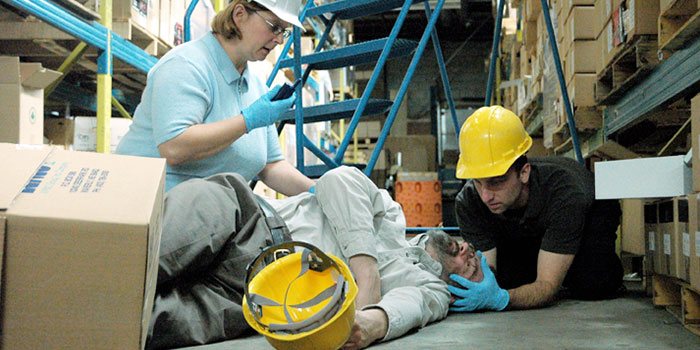
injured worker lying slumped against wall with person giving first aid.

WorkSafeBC Accepts Red Cross Blended Emergency First Aid as OFA 1 Equivalent

BC employers will be happy with a recent announcement from the Canadian Red Cross. Effective June 15, 2020, WorkSafeBC accepts Canadian Red Cross Blended Emergency First Aid as OFA Level 1 equivalent.

What is Emergency First Aid?

Emergency First Aid is a Canadian Red Cross training course that includes essential lifesaving first aid and CPR skills for the workplace and home. The course meets legislation requirements for provincial/territorial worker safety and insurance boards. It follows the latest first aid and CPR guidelines.

What does Blended Emergency First Aid mean?

A blended course includes an online component as well as an in-person session. Students complete an online course where they learn the theory behind the first aid skills. Following this, they attend a practical skills class where they get hands-on practice. During this session, they will complete a multiple-choice test.

How does Blended Emergency First Aid benefit employers?

Instead of employees taking a full day off work to attend a classroom-based course, they can now take a half-day. Participants will complete the online portion of the course at home or in the workplace before the classroom session. Workers will have less time away from the workplace. This reduces the need for employers to find cover, saving time and money.

Where does the practical skills session take place?

The Blended Emergency First Aid skills session can take place onsite in the workplace or at a local training venue.

Emergency First Aid Blended – About

Duration

Blended EFA with CPR C (adult, child and infant skills):
4.5 hours in-class + 4 hours online learning**

Regular EFA with CPR C:
7.5 hours in-class

Completion

  • Successfully demonstrate skills and critical steps
  • Min. 75% mark for written knowledge evaluation
  • Attend and participate in 100% of the course

Certification

3-year certification in Emergency First Aid and CPR Level C

Recertification*

EFA with CPR C: 5 hours in-class OR 4 hours in-class + 4 hours online learning**

Hands typing on computer keyboard

Course Content

  • The Red Cross
  • Preparing to respond
  • The EMS system
  • Check, Call, Care
  • Airway emergencies
  • Breathing and Circulation emergencies
  • First aid for respiratory and cardiac arrest
  • Wound care
  • Includes any other content required by specific legislation

Participant Materials

  • First Aid & CPR (eBook)
  • Emergency First Aid – Online (Blended only)
  • Emergency First Aid certificate (digital certificate issued upon successful completion)
  • Printable version – Emergency First Aid

*Recertification not available in all jurisdictions.

**Online learning time will vary depending on the learner.

Interested in Private Group Training for your team? Please contact us and ask for a quote.


Students in first aid class doing CPR wearing face masks.

Onsite Emergency First Aid Training at Vancouver Film Studios. June 2020.

workers providing first aid to injured co-worker

Why get staff trained in first aid?

There are more advantages than you might think.

Most conscientious employers have “Get staff trained in first aid” somewhere on their to-do list. How high up this item appears on the list may depend on their previous experience of accidents and injuries in the workplace or knowledge of the advantages of first aid training.

Safety Training Makes Sense

In workplaces, where employees have suffered severe injuries or death, employers have learned from bitter experience that safety should always be the number one priority. Think about it, if your staff members are trained to check for dangers and deal with hazards, there will be fewer accidents and injuries at your workplace and less downtime. Also, you’ll likely see a boost in morale as workers are happier and more productive if they feel like employers care about their safety.

What about the bottom line?

As well as the human suffering that often results from serious accidents, there will also be an impact on the bottom line. Employers often make decisions based on savings in time and money. If you’re asking yourself the question, “Will getting my staff trained in first aid save me time and money?” the answer is yes!

Don’t learn the hard way

Employers don’t have to learn about the advantages of safety and first aid training the hard way, though. All they need to do is be smart about safety training and practices and make arrangements for their staff to get trained through a recognized course provider.

Online or Classroom Training?

All employees need safety training. Workers can complete some of this online, but for first aid, you need to send your people to a classroom-based course. With first aid and CPR training, there is no substitute for getting hands-on experience working with a CPR mannequin, AED and other first aid equipment and supplies. In a classroom setting, participants get expert instruction and direct feedback from a certified instructor.

Use the Services of a recognized Training Provider

The Canadian Red Cross has been offering first aid and CPR training to Canadians for over 50 years and is one of the leading providers of first aid and CPR programs in Canada. Safe + Sound First Aid Training is proud to have been a Canadian Red Cross Training Partner since 1999. The Red Cross courses and certifications we offer are nationally recognized and accepted in BC by Child Care Licensing, Adult Care Licensing and WorkSafeBC.

Eight reasons to get your staff trained in first aid & CPR

  1. It saves lives!
  2. It will save you money. Less downtime = increased productivity.
  3. Your workers will be safer in and outside of the workplace.
  4. Employees will be able to act quickly, confidently and effectively in emergencies.
  5. Your worker safety and insurance board will be pleased with you.
  6. It’s a great team-building exercise.
  7. You’ll see an increase in morale; people like to work for employers who care about their safety.
  8. You’ll have one less thing on your “to-do” list, and maybe you’ll sleep better at night.

Group First Aid Training is Easy to Organize

Providing first aid and CPR training for employees is a smart, low-cost investment that helps ensure workplace health and safety. If you’re thinking about organizing first aid and CPR training in your workplace, please contact us, or complete our Group Training Form and we’ll be happy to help.

Gill McCulloch

Safe + Sound First Aid Training

learnfirstaid.ca

604-945-7277