Opioid Overdose: Four Things We Can Do Today to Stop Senseless Deaths

While experts work on long-term solutions to the opioid epidemic, the rest of us can take action now to save lives.


The world is struggling with two major health emergencies: COVID-19 and the opioid epidemic.

While COVID-19 is constantly in our thoughts, the opioid epidemic may not be top of mind for most. But, for first responders kneeling on cold sidewalks injecting Naloxone into unconscious casualties and parents who’ve just found their teenager dead in bed from an overdose, it’s a devastating reality.

Government health agencies have given us reams of instructions for protecting ourselves from the COVID-19 virus. They’ve not yet, however, provided clear guidelines about preventing death from an overdose. Healthcare professionals are urgently searching for solutions to the opioid crisis. Meanwhile, this article will outline four action steps people can take to start saving lives today.

The overdose epidemic does not discriminate

I have two kids aged 19 and 22. My daughter is a university student living at home, and my son shares an apartment with friends in Vancouver. I worry about them taking risks and getting poisoned by drinks or drugs laced with fentanyl or worse.

My husband and I have done our best to be good parents, teach our kids right from wrong and talk openly about uncomfortable topics like addiction. The overdose epidemic doesn’t discriminate, though, and being a good kid from a good home doesn’t make you immune to death by overdose.

Across the globe, lives are being ruined and lost at alarming rates, and communities large and small are feeling the impacts. According to the latest World Drug Report, an estimated 585,000 people died due to drug use in 2017. Opioids account for more than 70% of drug-related deaths, with more than 30% of those deaths caused by overdose.

Stop the blame game

People love to blame others for bad things that happen in the world. The opioid epidemic is one of the worst disasters of our time, and the internet is full of articles, videos, reports, and TED talks about the whodunit. Theories about what started this global crisis and why it continues include:

  • Massive marketing efforts by large pharmaceutical companies
  • Doctors over-prescribing pain medications
  • Dealers smuggling dirty drugs across borders
  • Lack of support for those with mental health issues
  • Stigma towards people struggling with addiction

Focusing on who’s to blame is not the best use of our time when loved ones are dying in bedrooms, gutters, and coffee shop bathrooms. We’d be wiser to focus on finding solutions to this colossal crisis or at least support groups trying to do this.

Organizations are tackling the problem from all angles. They’re looking at housing the homeless, creating employment opportunities, and decriminalizing drugs. Health agencies continue to develop harm reduction programs like safe drug supply and needle exchange programs. Advocacy groups and community action teams hold awareness events, and educators focus on prevention by delivering drug and alcohol presentations in schools.

But what can the rest of us do to prevent senseless deaths from an opioid overdose?

How we can help:

Here are four things we can do to stay safer and equip ourselves with skills to help a person suffering from an opioid overdose.

  • Ask questions about pain management before accepting prescriptions for opioid painkillers.
  • Educate ourselves with first aid, CPR, and Naloxone training.
  • Learn about the Lifeguard app.
  • Check-in with loved ones.

1. Pain management

During the week of my final exams at university, I had three wisdom teeth removed. The timing was unfortunate, but my teeth wouldn’t wait. The day after my teeth came out, I had an exam. From a corner of the auditorium ceiling, I remember looking down at myself working on my test. I have no idea what kind of painkillers the dentist gave me, but they were strong.

Years later, I took my teenaged son to have a wisdom tooth removed. The dentist prescribed Oxycodone-Acetaminophen for the pain. His advice was, “Take the pain meds straight away. Day three is the worst if you don’t keep up with painkillers. Don’t try to tough it out.”

Also known as Percocet, this medication controls pain but is highly addictive. In my son’s pill bottle, there were 24 tablets — twenty-four strong opioid pills for a sore tooth.

I cautioned my son about the dangers of opioids and advised him to switch to Tylenol sooner than later. Fortunately, his pain was short-lived, and he only took one of the Percocet tablets. His mouth healed quickly, and that was the end of the story. For others, a single prescription of opioid painkillers following an injury or operation can lead to the slippery slope of opioid misuse and sometimes, tragically, death.

According to the Mayo Clinic,

“The length of time you use prescribed opioids also plays a role in potential addiction. Researchers have found that taking opioid medications for more than a few days increases your risk of long-term use, which increases your risk of addiction. The odds you’ll still be on opioids a year after starting a short course increase after only five days on opioids.”

There’s a place for opioids in pain management; however, there are serious risks associated with their use. It’s critical we carefully consider these risks alongside their benefits. It’s up to us to ask questions, educate ourselves, and take responsibility for our health.

Doctors can provide information about pain management that doesn’t involve prescription opioids. Some options may work better and have fewer risks and side effects. These include pain relievers such as acetaminophen, ibuprofen, naproxen, physical therapy, exercise, and cognitive behavioural therapy.

What can we do?

  • Ask questions about pain medications and avoid prescribed opioids. Before an operation or medical procedure, ask what painkillers the doctor or surgeon is planning to use. If they prescribe an opioid analgesic, ask what alternate drugs and pain management strategies are available.
  • Search medicine cabinets for expired medications and take them to the local pharmacy for safe disposal.

2. Educating ourselves — First Aid and Naloxone training

Last year a friend was walking in downtown Vancouver when she found a man unconscious on the sidewalk. As she was calling 911, a passing cyclist stopped, threw a Naloxone kit onto the street beside her, and cycled off. Our friend knew what Naloxone was but had never used it before. She unzipped the kit, quickly read the instructions, injected the drug into the man’s arm, and saved his life.

How Naloxone works:

Naloxone can quickly reverse the life-threatening effects of an opioid overdose. In the brain, Naloxone and opioids bind to the same receptor sites. If too many opioids are attached to these receptors, breathing can slow or stop. Naloxone knocks opioids off the receptors and reverses the effects of the drugs temporarily, restoring breathing.

Naloxone is a safe drug with a low risk of serious side effects. If given to a person who is not experiencing an opioid overdose, it does no harm. You can administer Naloxone by injection or by nasal spray. It’s easy to do, but it helps if you’ve taken a short course or at least watched a how-to video.

First Aid & CPR Training:

As breathing is affected during an overdose, we need to know how to give a person rescue breaths. People learn rescue breathing, CPR, and other skills during a first aid course. Those looking to learn or refresh their first aid skills can find a class via their local Red Cross agency.

Mental Health first aid teaches people how to recognize when someone is struggling with a decline in their mental health or experiencing a mental health crisis. The training gives participants knowledge and skills to assist them.

What can we do?

3. The Lifeguard App can help save people who use drugs alone

The vast majority of fatal overdoses occur when people are using drugs alone. Lifeguard is a free phone app (on the ios app store and Google Play). The app brings emergency responders to people who may be overdosing on drugsThe purpose of the app is to reduce the risk of fatal overdose for individuals using alone.

How the Lifeguard app works:

When a person is ready to use their drug, they open the app, Select the drug they’re using and start the app timer. Before the timer begins, they confirm their address and provide additional details to help emergency services find them if needed. Then they tap the start button to activate the timer. The timer begins to count down from one minute. With 10 seconds remaining, an alarm will start to sound and get progressively louder. To silence the alarm, they can tap the stop button. If they’re unable to stop the alarm and the Lifeguard app will contact EMS.

EMS will call their mobile phone immediately to confirm they are OK. If they don’t answer the phone, Emergency Services will send an ambulance. The app’s alarm will continue to sound to help paramedics find the person. The Lifeguard app can also connect people to EMS/911, the 811 nurses line, the suicide prevention line, and the crisis intervention line.

What can we do?

4. Check in with loved ones

Now, more than ever, people are struggling with their mental health. The COVID-19 pandemic has led to increased isolation, and many people turn to substances because they are lonely. Those who live alone are especially at risk of depression, and if they also use drugs, death from overdose.

In an excellent article in Psychology Today, Robert Weiss, Ph.D., MSW, suggests,

“Addiction is not about the pleasurable effects of substances, it’s about the user’s inability to connect in healthy ways with other human beings. In other words, addiction is not a substance disorder, it’s a social disorder.”

Weiss talks about how people with substance use issues need to connect with safe, supportive, reliable, empathetic people in order to recover.

Addiction isolates people.

People may use substances to cope with depression, anxiety, and stressful situations — avoiding their feelings — and reality. They may cover up their fear and guilt with angry outbursts and emotionally abusive behaviours.

“Hurt people, hurt people.”

― Yehuda Berg

Those struggling with addiction are hurting — and in turn, they may hurt their friends and family, damaging relationships. As the disease progresses and the person’s isolation increases, the result may be death from despair.

What can we do?

  • Check-in with loved ones — elderly relatives, teenagers, young adults living away from home, friends who live alone. How are they doing? How are they feeling? Do they need help with anything? Offer support.

Recap: Four ways we can help save lives

  1. Ask questions about pain management before taking opioid painkillers.
  2. Gain life-saving skills with first aid, CPR, and Naloxone training.
  3. Learn about the Lifeguard app and share the information.
  4. Check-in with loved ones regularly to see how they’re doing.

We can all do something to help prevent people from dying of an opioid overdose. And while we’re at it, let’s look after our mental and physical health so we don’t become a statistic in this escalating epidemic. Instead of being part of the problem, we can become part of the solution.

©Gill McCulloch, April 2021

References:

  1. NCBI: https://www.ncbi.nlm.nih.gov/pmc/articles/PMC5937046
  2. Addiction, Isolation and the Cycle of Loneliness. https://vertavahealth.com/blog/addiction-isolation-and-the-cycle-of-loneliness/
  3. The Folly of Fr. Martin & The Power Of Connection. https://sobertostay.com/the-folly-of-fr-martin-the-power-of-connection
  4. Opioid overdose — World Health Organization. https://www.who.int/news-room/fact-sheets/detail/opioid-overdose
  5. Toward the Heart.com, Naloxone Saves Lives video
  6. The United Nations Office on Drugs and Crime (UNODC) ‘World Drug Report 2019’
First aid manikin and AED

WorkSafeBC Accepts Red Cross Blended Standard First Aid as OFA Level 1 Equivalent

Did you know WorkSafeBC accepts Canadian Red Cross Blended Standard First Aid as OFA Level 1 equivalent?

How does Blended Standard First Aid benefit employers?

Instead of employees taking two full days off work to attend a classroom-based course, they are now out of the workplace for a single day. This reduces the need for employers to find cover, saving time and money.

What is Standard First Aid?

Standard First Aid is a Canadian Red Cross training course that includes essential lifesaving first aid and CPR skills for the workplace and home. The course meets legislation requirements for provincial/territorial worker safety and insurance boards. It follows the latest first aid and CPR guidelines.

What does Blended Standard First Aid mean?

A blended course includes an online component as well as an in-person session. Students complete an online course where they learn the theory behind the first aid skills. Following this, they attend a practical skills class where they get hands-on practice with equipment in the classroom. During this session, they will complete a multiple-choice test.

What’s the difference between Standard First Aid and Standard First Aid Blended?

With the regular Standard First Aid program, students attend 16 hours of in-person training in the classroom. Classes usually take place over two days. With Blended Standard First Aid training, participants complete the online, theory portion of the course at home or in the workplace. Following this, they attend a full-day, in-person skills session in the classroom.

Where does the practical skills session take place?

The Blended Standard First Aid skills session can take place onsite in the workplace or at a local training venue. You can schedule a group training session at your workplace or register your team members on a public course.

Standard First Aid Blended – About

Duration

Standard First Aid with CPR C Blended includes 16 hours of training –  8 hours of online learning + 8 hours in-person training. Online learning time will vary depending on the learner.

Regular Standard First Aid with CPR C includes 16  hours of in-person training

Completion Requirements

  • Attend and participate in 100% of the course
  • Successfully demonstrate practical first aid skills and critical steps
  • Achieve a minimum 75% mark for written knowledge evaluation

Standard First Aid Certification

Red Cross Standard First Aid & CPR certification is valid for three years from the date the certificate is issued. After three years, the full course must be repeated to maintain certification. A shorter, recertification class may be taken before the initial certificate expires.

Standard First Aid Course Content

  • The Red Cross
  • Responding to Emergencies
  • Check, Call, Care
  • Choking
  • Circulation emergencies
  • CPR and AED
  • Breathing Emergencies
  • Wound Care
  • Head, Neck, and Spinal Injuries
  • Bone, Muscle and Joint Injuries
  • Sudden Medical Emergencies
  • Environmental Illness
  • Poisons
  • Includes any other content required by specific legislation

Participant Materials

  • First Aid & CPR (eBook)
  • Standard First Aid – Online course (8 hours)
  • Standard First Aid certificate (digital certificate issued upon successful completion)
  • Printable version – Standard First Aid

Standard First Aid Private Group Training

Interested in Private Group Training for your team? Please contact us and ask for a quote.

Safe + Sound Private group training, onsite at Vancouver Film Studios.

child in red cross babysitting class

Online Babysitting Training – Frequently Asked Questions

Virtual Babysitting Training, also called Online Babysitting Training, became very popular during the COVID-19 pandemic. The Canadian Red Cross developed the Virtual Babysitting course as a response to concerns from parents about children attending in-person group classes. Since then, the program has become so popular that parents, caregivers and group leaders often choose virtual training over in-person classes. Virtual classes are convenient for children and parents and they are especially beneficial for those who live in remote areas or can’t get to course locations easily.

Red Cross Babysitting Training includes basic first aid and caregiving skills for youth aged 11–15 years old. Participants learn how to provide care to younger children in a variety of age groups and how to prevent and respond to emergencies. The course also offers youth the training to promote themselves safely as a babysitter to prospective parents.

Please find below some of the questions parents and caregivers most commonly ask us about Babysitting training.

FAQs about Virtual Babysitting Training

Age

Q: How old do you have to be to take a Virtual Babysitting course?

Participants must be 11 years of age or older (or must have completed Grade 5). The Virtual Babysitting course is designed for children aged 11-15 years.


Q: My child is not yet 11 years old. Is there an online safety course they can take?

Children aged 9-13 can take our Home Alone Safety for Kids online course.


Course fees

Q: How much does a Red Cross Babysitting course cost?

You can find course information and current pricing here


Course length and timing

Q: How long is a Red Cross Virtual Babysitting class?

A Red Cross Virtual Babysitting class is 7 hours long including breaks.


Q: Is the Red Cross Babysitting course a one-day class, or is it split into two or more sessions?

A Red Cross Babysitting course can be run over one day or be split into two or more sessions.


Qualifications and certification

Q: What are the qualifications of a Red Cross Babysitting course instructor?

Red Cross Babysitting course instructors are certified Red Cross Youth Leaders.


Q: Will my child get a certificate after taking their Red Cross Babysitting class?

Yes. Children receive a Red Cross Babysitting participation certification upon completion of the class.


Q: When my child has taken a Red Cross Virtual Babysitting course, will they be qualified to babysit?

Your child will gain useful skills and knowledge from the babysitting course. After the class, they will be more prepared and confident to babysit. The Babysitting course is a participation class. There is no testing of skills and, therefore, no “qualification.” Whether or not the child is ready to take on the responsibility of babysitting is left to the discretion of the child’s parent or guardian.


Group Size

Q: How many participants are there in a Virtual Babysitting class?

The Canadian Red Cross allows a maximum of 15 children in a Virtual Babysitting class.


Course Topics

Q: What topics are included in a Red Cross Virtual Babysitting course?

On a Red Cross Babysitting course, children learn:

  • How to look after babies, toddlers, preschoolers, and school-age children.
  • Care for himself/herself and siblings when home alone.
  • Create a safe environment, and deal with phone calls and unexpected visitors.
  • React confidently in case of an emergency, such as choking, bleeding, poisoning or burns.
  • Cope with common problems, such as tantrums and crying.
  • Play games and organize activities to keep kids of all ages entertained.
  • Manage a babysitting business. This includes creating a resume and a business card and asking the right questions before accepting a babysitting job.

First Aid Content includes:

  • Check, Call, Care (includes phoning EMS/911)
  • Glove removal
  • Recovery position
  • Conscious choking (adult/child/baby/alone)
  • CPR (baby/child)
  • Illness
  • Asthma (includes use of inhaler and spacer)
  • Anaphylaxis (includes use of EpiPen)
  • Poisoning
  • Insect stings
  • Wound care (i.e. minor cuts and scrapes, splinters, nosebleeds, bumps and bruises
  • Life-threatening bleeding, burns)
  • Head, neck and back injuries
  • Broken bones
  • Seizures

Private Group Virtual Babysitting Training

Q: Can I book a private Virtual Babysitting class for my group?

Yes. If you have 8-15 children aged 11-15 years, you can book a private Virtual Babysitting class for your group.


Course Materials

Q: What materials will I need to provide for my child for use during the Virtual Babysitting class?

When you register your child for the class, you will receive an email confirmation with course details, including what your child needs to have with them during the training. Your child will also receive a Red Cross Babysitting book and other materials in the mail. Here is a list of some of the items you may be asked to provide:

  • Doll or stuffed animal (to practice baby care – holding, carrying, burping, feeding, comforting etc.
  • Triangular bandage or clean tea towel (to practice bandaging life-threatening external bleeding.
  • Pair of disposable gloves or any gloves available in the home (to practice safe glove removal.
  • Thick marker pen or something that looks similar (to practice using an EpiPen)
  • Pen and paper for note-taking
  • Water bottle

There is no need to buy any of the above items. Children are encouraged to improvise with things they can find around the home.

Q: Will my child get a Red Cross Babysitting book with their course?

Yes. Red Cross Babysitting course students receive a copy of the Red Cross Babysitting book in the mail. If they register at least a week before the class, they should get their book before their class. If they register later, they will receive their book and their Babysitting certificate after the class.


Technical Info

Q: Do participants have to set up a Zoom account to take a virtual Babysitting class?

Participants are not required to have a Zoom account to participate in a Red Cross Babysitting class. We will email a link to each participant before the class. Participants need access to a computer with a webcam and microphone. This must be turned on for the duration of the class.


Legal Questions

Q: What is the legal age for babysitting in BC, Canada?

A: There is no age specified by law for babysitting. The parent determines if a child is responsible enough to provide a safe environment for the younger children in their care. Canadian social services organizations advise that children under 12 years should not be left at home alone.


Q: What is the legal age for leaving children unsupervised in Canada?

This is a difficult question, as the guidelines vary in different provinces. In British Columbia, there is no legislated minimum age for leaving a child alone for a short period. However, according to a B.C. Supreme Court decision, children under the age of 10 should not be left unsupervised at home.

This is a complicated issue, and the guidelines are unclear. Please refer to this article:

Is your child ready to stay home alone?


Course Registration

Q: How can I register my child in a Red Cross Virtual Babysitting class?

You can find information, a schedule and online registration for Virtual Babysitting classes here. We look forward to meeting your child and their friends soon!


Q: Where can I find information about Home Alone training?

You can find information and registration for Home Alone training for 9-13-year-olds here.

Questions about Babysitting and Home Alone training in Canada

Please contact us if you have any questions about Babysitting or Home Alone courses.

Electrical sparks on dark background

A Shocking Experience Taught Me a Valuable Safety Lesson

When I got up that morning, I wasn’t expecting to wind up electrocuted and left for dead. The consequences of a careless mistake taught me a valuable safety lesson, and by sharing it with others, I hope to save some lives.


Everything seemed to be going smoothly that fateful day until I heard,

Zzzt zzzt zzzt — and a man shouting at me,

“Lie down on the ground! Don’t move!”

“What happened?” I asked.

“You touched a cable, and you’ve been electrocuted,” he replied. Keep still.

I lay on the ground — shocked.


An emergency scene

As I looked around, it became apparent a bus had crashed, and there were multiple casualties. I listened to the cries of the injured passengers while bystanders asked questions in urgent voices,

“Did you see what happened?”

“Where are you hurt?”

“Did you hit your head?”

“You — in the blue shirt, call 911 and report back to me”.

Utter chaos.


Helpless and frustrated

Most unbearable was being unable to help. From my horizontal position, I assessed the scene and thought about everything I could be doing for the injured people around me.

I’d been trained in first aid, but because I’d forgotten to check for danger before rushing to help, I’d become a casualty and was now useless. Silently, I coached the helpers as they gave CPR, bandaged wounds, and supported broken limbs.

Finally, the man who told me I’d been electrocuted called a stop to the proceedings.

“So,” he said, chin down, eyebrows raised, wide eyes looking pointedly at me. “What have we all learned from this exercise?” Cringing with embarrassment, I slowly raised my hand.


First aid scenario

It was the end of a two-day Red Cross Standard First Aid & CPR class and time to put our new skills to the test. The instructor had split us into two groups and told my group to wait in the hallway. After a while, we’d be called in to deal with an emergency scene and would have to give first aid to any casualties we found.

The instructor set up the room with the other class members while we waited nervously in the hallway. A few minutes later, he flung open the door with a look of panic. “Help! Quick! There’s been a terrible accident. People are injured!”


The crucial question

As instructed, before entering the room, I asked the question, “Is the scene safe?” The instructor paused before answering, “The scene appears — to be safe.” In hindsight, I should’ve listened more carefully to the emphasis he put on the word appears.

Hearts thumping, adrenaline pumping, my classmates and I rushed into the room and looked around. We saw injured people everywhere, moaning, groaning, crying, dying, pools of fake blood on the floor. I ran to a man lying on his back with his eyes closed. Kneeling beside him, I began to check for responsiveness, and that’s when I heard the ominous sound,

Zzzt zzzt zzzt

I looked up in confusion to find the instructor standing beside me. He told me I’d just been electrocuted and pointed to the floor by my casualty’s chest. I noticed I was kneeling on a wire trailing beneath the man’s body.


In my rush to save a life, I’d killed myself.


A humiliating moment and a powerful lesson

The instructor told me to lie quietly beside my casualty as I was now dead and unable to help him. I lay on the ground, humiliated, while the other students in my group saved their injured people. It was a humbling moment. Until that point, I’d felt pretty confident in the skills I’d learned during the course, but as I lay helpless beside my dying person, I knew I’d missed the most critical step.

I vowed NEVER to make the same mistake again.

Rushing around, not paying attention are common reasons people have accidents. That day, I learned a vital lesson. Whenever you go into a room or a new environment, always check for dangers.

Look up, down, all around. Is there something you could trip on, slip on? Is there fire, wire, gas, glass, drugs, or thugs?


Remember — If you’re killed or injured, you can’t help anyone.


I completed my training, became a Red Cross first aid instructor, and opened Safe + Sound First Aid Training (still going strong 21 years later). Over the years, I’ve taught hundreds of first aid & CPR courses and trained thousands of people. I’ve electrocuted many students in first aid scenarios. I hope it’s taught them the same valuable lesson I learned years ago. By sharing the story of my deadly mistake, I hope I’ve saved some lives.

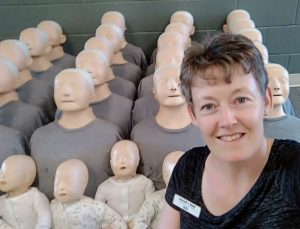
First aid instructor in foreground with CPR manikins behind

Gill McCulloch, Owner, Safe + Sound First Aid Training Ltd.


Take a first aid course and learn to save a life.


injured worker lying slumped against wall with person giving first aid.

WorkSafeBC Accepts Red Cross Blended Emergency First Aid as OFA 1 Equivalent

BC employers will be happy with a recent announcement from the Canadian Red Cross. Effective June 15, 2020, WorkSafeBC accepts Canadian Red Cross Blended Emergency First Aid as OFA Level 1 equivalent.

What is Emergency First Aid?

Emergency First Aid is a Canadian Red Cross training course that includes essential lifesaving first aid and CPR skills for the workplace and home. The course meets legislation requirements for provincial/territorial worker safety and insurance boards. It follows the latest first aid and CPR guidelines.

What does Blended Emergency First Aid mean?

A blended course includes an online component as well as an in-person session. Students complete an online course where they learn the theory behind the first aid skills. Following this, they attend a practical skills class where they get hands-on practice. During this session, they will complete a multiple-choice test.

How does Blended Emergency First Aid benefit employers?

Instead of employees taking a full day off work to attend a classroom-based course, they can now take a half-day. Participants will complete the online portion of the course at home or in the workplace before the classroom session. Workers will have less time away from the workplace. This reduces the need for employers to find cover, saving time and money.

Where does the practical skills session take place?

The Blended Emergency First Aid skills session can take place onsite in the workplace or at a local training venue.

Emergency First Aid Blended – About

Duration

Blended EFA with CPR C (adult, child and infant skills):
4.5 hours in-class + 4 hours online learning**

Regular EFA with CPR C:
7.5 hours in-class

Completion

  • Successfully demonstrate skills and critical steps
  • Min. 75% mark for written knowledge evaluation
  • Attend and participate in 100% of the course

Certification

3-year certification in Emergency First Aid and CPR Level C

Recertification*

EFA with CPR C: 5 hours in-class OR 4 hours in-class + 4 hours online learning**

Hands typing on computer keyboard

Course Content

  • The Red Cross
  • Preparing to respond
  • The EMS system
  • Check, Call, Care
  • Airway emergencies
  • Breathing and Circulation emergencies
  • First aid for respiratory and cardiac arrest
  • Wound care
  • Includes any other content required by specific legislation

Participant Materials

  • First Aid & CPR (eBook)
  • Emergency First Aid – Online (Blended only)
  • Emergency First Aid certificate (digital certificate issued upon successful completion)
  • Printable version – Emergency First Aid

*Recertification not available in all jurisdictions.

**Online learning time will vary depending on the learner.

Interested in Private Group Training for your team? Please contact us and ask for a quote.


Students in first aid class doing CPR wearing face masks.

Onsite Emergency First Aid Training at Vancouver Film Studios. June 2020.

Psychological First Aid Training Can Save Lives - Close-up of a devastated young man holding his head in his hands and a group of friends in a supportive pose around him

Psychological First Aid Can Save Lives

Who can benefit from Psychological First Aid training?

First aid for the mind is just as important as first aid for the body. Like physical first aid, psychological first aid training can save lives. Individuals suffering from high-stress levels, burnout and suicidal thoughts are at an all-time high in areas such as workplaces, schools, indigenous communities and among professional responders.

The Canadian Red Cross Psychological First Aid course is a resiliency building wellness program. The course equips learners to develop a personal understanding of the effects of stress, loss, trauma and grief on others, emphasizing self-care and personal protection. The course uses primarily case-based learning and includes the latest evidence from the international community.

Psychological First Aid course schedule and online registration 

Psychological First Aid Course Details

Course fee
$115.00 + GST per person

Audience
The course is adaptable to all audiences (Youth, Workplace, Professional Responder)

Duration
45-90 minutes online learning and 7 hours in-class

Instructor
Canadian Red Cross Psychological First Aid Instructor

  • Prerequisites
    16 years of age (recommended)
  • Psychological First Aid – Self-Care online course (required for blended option only)
    Completion
  • Participate in 100% of the in-class course
  • Complete the online course: Psychological First Aid – Self-Care (required for blended option only)

Certification
3-year Red Cross certification in Psychological First Aid

Course Content
Case-based learning and discussion will be tailored to the audience and include the following content:

Psychological First Aid Training Can Save Lives - Image of two people sitting on a park bench with one comforting the other.

  • Introduction to Red Cross
  • Case Studies
  • Psychological First Aid
  • Operational Principles
  • Stress, Distress
  • Loss and Grief
  • Trauma
  • Indicators
  • Vulnerable Populations
  • Supportive Communication
  • Look, Listen, Link, Live
  • Resiliency and Protective Factors
  • Protection
  • Policies, Legislation
  • Self-Care
  • Participant Materials
  • Psychological First Aid Workbook (print)
  • Look, Listen, Link, Live cards
  • Psychological First Aid–Self-Care online course (required for blended option)
  • Psychological First Aid–Caring for Others online course (optional)

More info about Psychological First Aid from the Canadian Red Cross website

Frequently Asked Questions about Psychological First Aid

Q: Is Red Cross Psychological First Aid a nationally recognized certification?

A: Yes. The Red Cross Psychological First Aid certification is recognized across Canada.

Q: Can I book a private Psychological First Aid course for my team?

A: Yes. Please contact us for pricing onsite training information.

Q: What is the difference between Psychological First Aid and Mental Health First Aid? 

A:  Mental Health First Aid focuses on primarily educating professional responders on the signs, symptoms, and care for various types of mental health issues.

Psychological First Aid offers a daily aid to dealing with the stresses of life for individuals within a broad spectrum of communities.

Q: Do participants get a certificate after completing a Psychological First Aid course?

A: Yes. You will receive certification from the Canadian Red Cross.

CRC-Psychological-First-Aid-Guide-2019

Psychological First Aid Can Save Lives.
Register for a class now or book a group training session for your team.

First aid training classroom with physical distancing layout

First Aid Training During COVID-19 – What We’re Doing to Keep You Safe

If you need to update your first aid certification, you may be concerned about whether it’s safe to take an in-person class during COVID-19 restrictions. This article explains what you can expect in a first aid class and what we’re doing to ensure your health and safety. We hope the information below will reassure you about registering for a course or booking a private group training session for your team.

Safe + Sound First Aid Training is following WorkSafe BC and Canadian Red Cross health and safety guidelines for first aid agencies.

Click here for our full COVID-10 Health and Safety Protocols

Woman wearing face mask standing near table and hand sanitizer stand.

On arrival at your first aid class, a friendly staff member will greet you and ask you to use hand sanitizer before completing a health screening questionnaire.

Brief outline

Participants:

  • Receive health and safety information via email before the class.
  • Are required to show proof of Covid-19 vaccination on arrival at the course location.
  • Complete a health screening questionnaire before entering the classroom.
  • Are required to wash/sanitize their hands before, during and after class.
  • Wear a mask before entering the classroom and throughout the course.
  • Are spaced at least 2 metres apart in the training room.
  • Have their own manikin, equipment, and supplies.
  • Are given a disposable, one-way valve with a filter to use with their CPR breathing mask.
  • Use equipment that has been sanitized following WorkSafeBC and Canadian Red Cross guidelines.

Health screening

Before admittance into the class, participants must complete a health questionnaire. This helps us determine if they have been ill or have had any signs of illness (fever, cough, breathing difficulties/shortness of breath, or other symptoms) within the last 24 hours, travelled outside of Canada within the previous 14 days or been in contact with someone who is ill. (Source Government of Canada https://ca.thrive.health/covid19/en) Participants with pre-existing conditions (e.g., allergies causing sneezing) are discouraged from attending training; this helps participants in the course feel secure.


COVID-19 Health Screening Questionnaire

Each student completes a health screening questionnaire before being admitted to class.


Face masks

We require that students and instructors wear face masks during the entire class. While this is slightly inconvenient, it gives people confidence that they will remain safe while spending a day in a room with other people.


Hand sanitizing

We ask participants to use hand sanitizer on arrival and wash their hands regularly throughout the day and at the end of the class. Washrooms are situated close to the classrooms.

Smaller group sizes and physical distancing

We have reduced our class sizes to meet physical distancing guidelines in our classrooms. Each student has a two-metre square area, with their chair and all the equipment and supplies they need for the class. Students are asked to remain in their area throughout the class, except during breaks.

Classroom layout

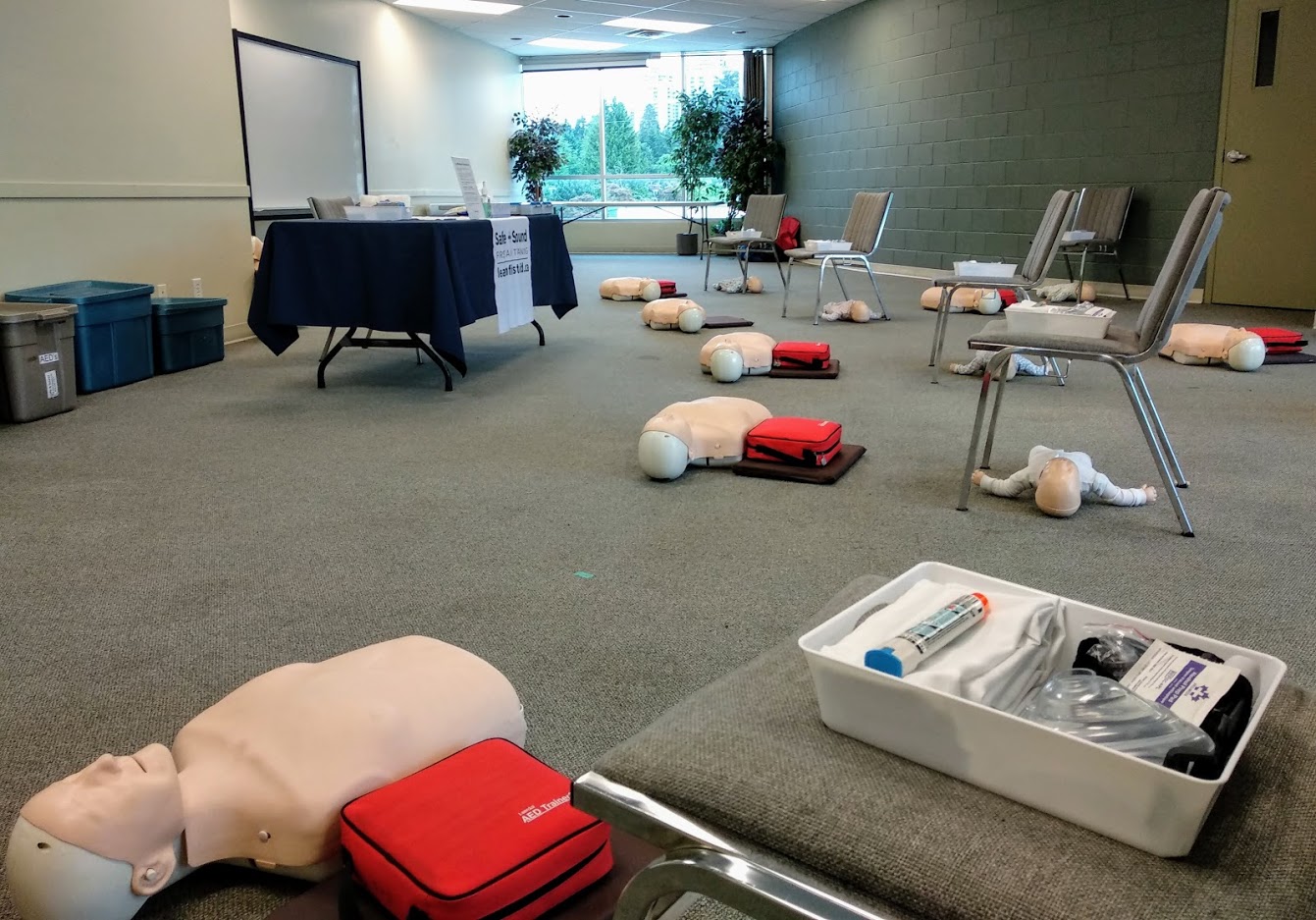
With current physical distancing guidelines, participants need to be separated by a minimum of 2 metres.  As you can see from the image, we have arranged our classroom to create individual stations where students remain during class.

First aid training classroom with physical distancing layout. Workstations are two metres apart.

First aid workstations are situated two metres apart in the classrooms.


Physical contact

Participants are not required to have any physical contact with other students or the instructor. Previously, some first aid skills like the recovery position, splints and slings, required people to work in pairs. We have come up with creative ways to teach these skills without students having physical contact with others.

Equipment – one to one ratios

Each student has an adult manikin, infant manikin, AED trainer (defibrillator), and first aid supplies to use during class. There is no sharing of equipment or supplies.

First aid class individual workstation with CPR manikins, AED trainer and first aid supplies

First aid class workstation. Each student has their own Mankins, AED, kneeling mat and first aid supplies. No sharing or physical contact with other students.

What about gloves and CPR breathing masks?

We give each student disposable vinyl gloves and a new, disposable one-way valve and filter to use with their CPR mask. Students may take the CPR masks home with them.

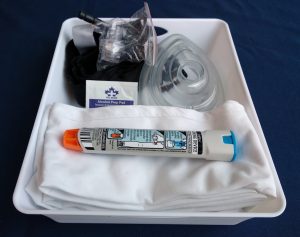
White plastic tray containing first aid supplies for use during a first aid class.

Each student has a tray containing the first aid supplies they need for the day.

Cleaning and sanitizing

Following guidelines from WorkSafeBC and the Canadian Red Cross, we sanitize all first aid equipment thoroughly after use.

Questions?

We hope the above information will reassure you about taking a class or booking a private class for your team. If you have any questions or concerns, please contact us.


Five star Google review for Safe + Sound First Aid Training, from first aid training client, June 2020

Google review from Emergency Child Care First Aid CPR course participant, June 2020. Thank you Becky! More Google Reviews


First aid course information, schedules and online registration


Private Group First Aid Training

Students in first aid class doing CPR wearing face masks.

June 2020. Private onsite group training at Pacific Backlot / Vancouver Film Studios. Workers learning CPR during a Red Cross Emergency First Aid (OFA 1) class.

Ignoring Small Injuries Can Have Serious Consequences

Take care of cuts and scrapes — don’t end up like Bill

None of us want to go to the doctor or hospital unless we have to, so we need to take good care of ourselves. A small injury that becomes infected can lead to a life or limb-threatening condition. 

A friend nearly lost his leg from a neglected scratch

A few years ago, I’d brought my dad into the ER at Royal Columbian Hospital. While we were sitting in the waiting room, an old family friend, hobbled in with his wife. I could see that Bill was struggling to walk, and I asked what had happened. 

He said he’d hurt his leg and pulled up his pant leg to show us. I was horrified! His leg was severely swollen, and the skin had a nasty, blue mottled appearance. He told us that he’d scratched the back of his ankle and hadn’t thought much about it until it started to get sore. His leg had become red, swollen and increasingly painful, so he went to the doctor. The doctor sent him straight to the ER. Every day for the next two weeks, Bill’s wife had to drive him to the hospital for IV antibiotic treatment. The doctors told Bill he was lucky he hadn’t lost his leg. 

First aid for a small cut or scrape

  • Cover the wound first and clean around the injured area using mild soap and gauze or an antiseptic wipe. Do not use iodine, alcohol, or hydrogen peroxide.
  • Once the area around the wound is clean, clean the cut with running water.
  • Remove any slivers or gravel with alcohol-sterilized tweezers.
  • Blot dry with sterile gauze.
  • Small cuts usually stop bleeding quickly, but if the wound is still bleeding, apply firm, gentle pressure with gauze. If blood soaks through, put another piece of gauze on top. Don’t remove the old one, or you might start the bleeding again.
  • Once the bleeding has stopped apply a small amount of antibiotic cream to reduce the risk of infection.
  • Cover the wound with a sterile dressing and change it every 24 hours.
  • Keep the dressing clean and dry. If the dressing becomes wet or dirty, replace it immediately. 
  • If the skin under the bandage feels itchy, you may have an allergy to the adhesive used in some bandages. For sensitive skin, try switching to sterile gauze and paper tape, or an adhesive-free dressing.

If you see signs of infection, seek medical advice without delay.

Recognizing signs of Infection

Signs of an infection include:

  • swelling
  • redness that spreads out from the injury
  • increased pain or tenderness
  • the area feels hot or warm to touch
  • oozing pus or liquid
  • swollen lymph nodes in the neck, armpit, or groin
  • body aches chills and fever
  • slow healing or wound doesn’t seem to be healing at all

If you have any of these signs, seek medical advice.

Baby touching woman's face

Why Register Your Child on a Babysitting Course?

Do you have a child aged 11-15 years? If so, you may be thinking about registering them on a Red Cross Babysitting course. To find out what your child will learn and the benefits of babysitting training, please read on.

A personal story

As a young teen, I remember being excited about finally being old enough to babysit. My first job was with a family who lived at the top of our street. The two boys I looked after, Robert and Charles, were 5 and 7 years old. I had no formal babysitting training, and I feel very grateful that I didn’t have to deal with any real emergencies while babysitting. The worst thing I remember happening is my fountain pen leaking blue ink onto the pale green carpet and calling my mom for advice. I was lucky, though. If Robert or Charles had choked on their food and stopped breathing or had a severe injury, I would not have known what to do; those young boys might have died in my care.

Babysitting for young children is an enormous responsibility. 

A babysitter needs to understand that when they look after a baby or young child, they have the life of another person in their hands. Babies and young children are vulnerable, unpredictable and accident-prone. A babysitter cannot afford to let their guard down for a moment. Some things are common sense, but others, like first aid skills, must be learned.


Why do parents register children on a Red Cross Babysitting course?

Parents recognize that Babysitting training is an investment in their children’s safety. Some of the reasons why they register their kids on Babysitting courses are listed below.


Red Cross Babysitting Training – Benefits to children and what they learn

The Canadian Red Cross created a Babysitting course specifically for young children aged 11-15. The course is designed to teach children the skills they need to be an excellent babysitter and how to be safer when home alone. Children learn how to care for babies and children of all ages, give first aid and deal with emergencies. The course also offers an overview of the responsibilities that go with being a babysitter. It teaches youth essential child care skills and also how to reduce hazards and prevent accidents.


Red Cross Babysitting Course Topics


Leadership

People who hire babysitters rely on them to be the leader and keep their children safe. On the course, children learn about how to be a responsible leader, different leadership styles, role modelling, respecting diversity, recognizing child abuse and neglect, and how to create a babysitting kit.


Childhood Characteristics and Behaviour

In this section of the course, children learn about the stages of development for babies, toddlers, preschoolers, school-aged children, babysitting for children with disabilities, assistive devices and service animals.


Creating Safe Environments and Personal Safety

Children learn to be safer when home alone. Topics include; dealing with strangers, answering the door, answering the phone in a way that doesn’t put them at risk, what to do in the event of a fire and how to call EMS/911. Children learn about personal safety and security, online safety and bullying behaviours. Also included, is information about community safety, street safety, bicycle and scooter safety, water safety and rural babysitting.


Caring for Children

A young babysitter needs to understand the importance of supervision, what information they should get from the child’s parent or guardian before they are left alone with the child. Other topics include; home safety, poison prevention and giving medications, suffocation and choking, how to change a diaper, how to feed babies and children of all ages, safe toys and activities for each age group. They will learn about dressing, sleeping, playing, comforting, safe vs. unsafe touching and misbehaviour.


First Aid Skills and Handling Emergencies

Children learn first aid skills, accident prevention, checking for hazards, and how to call EMS/911. Topics in this section of the course include choking, CPR, asthma, anaphylaxis, minor cuts and scrapes, splinters, life-threatening bleeding, nosebleeds, bumps and bruises, burns, head, neck and back injuries, broken bones, seizures, poisons, insect stings, sudden medical conditions or other medical emergencies

When your child has learned these skills, they are less likely to have an accident or suffer any injury, and you never know, they might save your life one day!


The Business of Babysitting

Children will learn how to find babysitting work safely and how to prepare for their first babysitting job. Other topics include how to write a resume, expectations of the family, children’s expectations, self-evaluation after the job, their own family’s expectations. Babysitting is an excellent way for young people to give back to the community, gain valuable training and develop essential leadership skills.


For more information or to register your child for a course in Coquitlam, please follow the link below. If you have any questions, please contact us.


Babysitting course schedule and online registration

Happy Holidays from Safe + Sound, and Thank You!

To our dedicated team of highly experienced instructors

We see and appreciate how much energy you put into your teaching and professional development. We love how you care for our clients with patience and kindness.

To the employers and agency case managers who have trusted us to train their staff and clients

We acknowledge you for seeing the value in safety training. We respect that you show your team members that you care about their safety by investing in first aid and mental health first aid training. Your workplace is safer because you give your people time off to take classes and learn first aid and safety skills. The families of your workers are confident that their loved ones will come home safely at the end of the day.

To our community champions and supporters, including the Tri-Cities Chamber of Commerce and its members

The Chamber is an organization that provides an excellent platform from which local businesses can network and learn while providing support and celebrating each other’s achievements. We appreciate all of the great friendships we have made with fellow business owners and also the referrals you send our way!

To our course attendees and all of the people who post good reviews about Safe + Sound

Thank you for your lovely positive feedback and for registering your family members on our courses. It makes us happy to know that you and your families are safer because of the skills you learn in our courses. We look forward to seeing you again when it’s time for a refresher.

Special thanks to the new immigrants and refugees

You have taken a leap of faith and courage to tackle a Red Cross class in a language that many of you are still learning, and we have the greatest admiration for you. We know how much a Red Cross certification means to you. We’ve seen your tears of joy and celebrated with you when you discover that you’ve passed your course. We know that you may be depending on this certification so that you can work and put food on the table for your families. We wish you happiness and success in your new life in Canada.

To everyone who is involved with Safe + Sound First Aid Training

Thank you for helping us to provide a much-needed service in our community. We appreciate you all very much and wish you a safe and happy time with your family and friends over the holidays.

Gill McCulloch, Director,
Safe + Sound First Aid Training Ltd.
learnfirstaid.ca