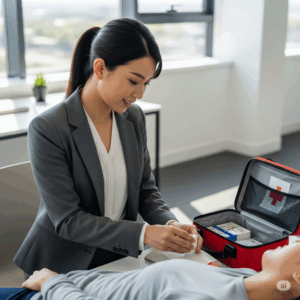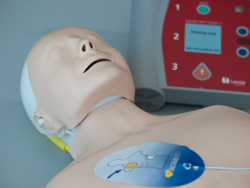
First aid manikin and AED

WorkSafeBC Accepts Red Cross Blended Standard First Aid as OFA Level 1 Equivalent

Did you know WorkSafeBC accepts Canadian Red Cross Blended Standard First Aid as OFA Level 1 equivalent?

How does Blended Standard First Aid benefit employers?

Instead of employees taking two full days off work to attend a classroom-based course, they are now out of the workplace for a single day. This reduces the need for employers to find cover, saving time and money.

What is Standard First Aid?

Standard First Aid is a Canadian Red Cross training course that includes essential lifesaving first aid and CPR skills for the workplace and home. The course meets legislation requirements for provincial/territorial worker safety and insurance boards. It follows the latest first aid and CPR guidelines.

What does Blended Standard First Aid mean?

A blended course includes an online component as well as an in-person session. Students complete an online course where they learn the theory behind the first aid skills. Following this, they attend a practical skills class where they get hands-on practice with equipment in the classroom. During this session, they will complete a multiple-choice test.

What’s the difference between Standard First Aid and Standard First Aid Blended?

With the regular Standard First Aid program, students attend 16 hours of in-person training in the classroom. Classes usually take place over two days. With Blended Standard First Aid training, participants complete the online, theory portion of the course at home or in the workplace. Following this, they attend a full-day, in-person skills session in the classroom.

Where does the practical skills session take place?

The Blended Standard First Aid skills session can take place onsite in the workplace or at a local training venue. You can schedule a group training session at your workplace or register your team members on a public course.

Standard First Aid Blended – About

Duration

Standard First Aid with CPR C Blended includes 16 hours of training –  8 hours of online learning + 8 hours in-person training. Online learning time will vary depending on the learner.

Regular Standard First Aid with CPR C includes 16  hours of in-person training

Completion Requirements

  • Attend and participate in 100% of the course
  • Successfully demonstrate practical first aid skills and critical steps
  • Achieve a minimum 75% mark for written knowledge evaluation

Standard First Aid Certification

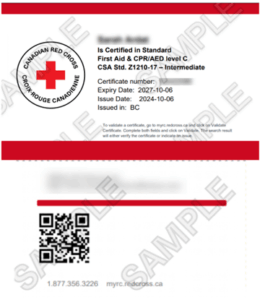
Red Cross Standard First Aid & CPR certification is valid for three years from the date the certificate is issued. After three years, the full course must be repeated to maintain certification. A shorter, recertification class may be taken before the initial certificate expires.

Standard First Aid Course Content

  • The Red Cross
  • Responding to Emergencies
  • Check, Call, Care
  • Choking
  • Circulation emergencies
  • CPR and AED
  • Breathing Emergencies
  • Wound Care
  • Head, Neck, and Spinal Injuries
  • Bone, Muscle and Joint Injuries
  • Sudden Medical Emergencies
  • Environmental Illness
  • Poisons
  • Includes any other content required by specific legislation

Participant Materials

  • First Aid & CPR (eBook)
  • Standard First Aid – Online course (8 hours)
  • Standard First Aid certificate (digital certificate issued upon successful completion)
  • Printable version – Standard First Aid

Standard First Aid Private Group Training

Interested in Private Group Training for your team? Please contact us and ask for a quote.

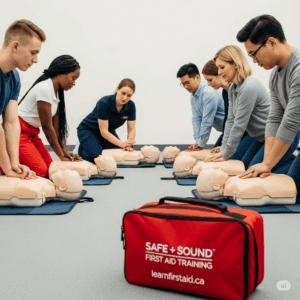
Safe + Sound Private group training, onsite at Vancouver Film Studios.

child in red cross babysitting class

Online Babysitting Training – Frequently Asked Questions

Virtual Babysitting Training, also called Online Babysitting Training, became very popular during the COVID-19 pandemic. The Canadian Red Cross developed the Virtual Babysitting course as a response to concerns from parents about children attending in-person group classes. Since then, the program has become so popular that parents, caregivers and group leaders often choose virtual training over in-person classes. Virtual classes are convenient for children and parents and they are especially beneficial for those who live in remote areas or can’t get to course locations easily.

Red Cross Babysitting Training includes basic first aid and caregiving skills for youth aged 11–15 years old. Participants learn how to provide care to younger children in a variety of age groups and how to prevent and respond to emergencies. The course also offers youth the training to promote themselves safely as a babysitter to prospective parents.

Please find below some of the questions parents and caregivers most commonly ask us about Babysitting training.

FAQs about Virtual Babysitting Training

Age

Q: How old do you have to be to take a Virtual Babysitting course?

Participants must be 11 years of age or older (or must have completed Grade 5). The Virtual Babysitting course is designed for children aged 11-15 years.


Q: My child is not yet 11 years old. Is there an online safety course they can take?

Children aged 9-13 can take our Home Alone Safety for Kids online course.


Course fees

Q: How much does a Red Cross Babysitting course cost?

You can find course information and current pricing here


Course length and timing

Q: How long is a Red Cross Virtual Babysitting class?

A Red Cross Virtual Babysitting class is 7 hours long including breaks.


Q: Is the Red Cross Babysitting course a one-day class, or is it split into two or more sessions?

A Red Cross Babysitting course can be run over one day or be split into two or more sessions.


Qualifications and certification

Q: What are the qualifications of a Red Cross Babysitting course instructor?

Red Cross Babysitting course instructors are certified Red Cross Youth Leaders.


Q: Will my child get a certificate after taking their Red Cross Babysitting class?

Yes. Children receive a Red Cross Babysitting participation certification upon completion of the class.


Q: When my child has taken a Red Cross Virtual Babysitting course, will they be qualified to babysit?

Your child will gain useful skills and knowledge from the babysitting course. After the class, they will be more prepared and confident to babysit. The Babysitting course is a participation class. There is no testing of skills and, therefore, no “qualification.” Whether or not the child is ready to take on the responsibility of babysitting is left to the discretion of the child’s parent or guardian.


Group Size

Q: How many participants are there in a Virtual Babysitting class?

The Canadian Red Cross allows a maximum of 15 children in a Virtual Babysitting class.


Course Topics

Q: What topics are included in a Red Cross Virtual Babysitting course?

On a Red Cross Babysitting course, children learn:

  • How to look after babies, toddlers, preschoolers, and school-age children.
  • Care for himself/herself and siblings when home alone.
  • Create a safe environment, and deal with phone calls and unexpected visitors.
  • React confidently in case of an emergency, such as choking, bleeding, poisoning or burns.
  • Cope with common problems, such as tantrums and crying.
  • Play games and organize activities to keep kids of all ages entertained.
  • Manage a babysitting business. This includes creating a resume and a business card and asking the right questions before accepting a babysitting job.

First Aid Content includes:

  • Check, Call, Care (includes phoning EMS/911)
  • Glove removal
  • Recovery position
  • Conscious choking (adult/child/baby/alone)
  • CPR (baby/child)
  • Illness
  • Asthma (includes use of inhaler and spacer)
  • Anaphylaxis (includes use of EpiPen)
  • Poisoning
  • Insect stings
  • Wound care (i.e. minor cuts and scrapes, splinters, nosebleeds, bumps and bruises
  • Life-threatening bleeding, burns)
  • Head, neck and back injuries
  • Broken bones
  • Seizures

Private Group Virtual Babysitting Training

Q: Can I book a private Virtual Babysitting class for my group?

Yes. If you have 8-15 children aged 11-15 years, you can book a private Virtual Babysitting class for your group.


Course Materials

Q: What materials will I need to provide for my child for use during the Virtual Babysitting class?

When you register your child for the class, you will receive an email confirmation with course details, including what your child needs to have with them during the training. Your child will also receive a Red Cross Babysitting book and other materials in the mail. Here is a list of some of the items you may be asked to provide:

  • Doll or stuffed animal (to practice baby care – holding, carrying, burping, feeding, comforting etc.
  • Triangular bandage or clean tea towel (to practice bandaging life-threatening external bleeding.
  • Pair of disposable gloves or any gloves available in the home (to practice safe glove removal.
  • Thick marker pen or something that looks similar (to practice using an EpiPen)
  • Pen and paper for note-taking
  • Water bottle

There is no need to buy any of the above items. Children are encouraged to improvise with things they can find around the home.

Q: Will my child get a Red Cross Babysitting book with their course?

Yes. Red Cross Babysitting course students receive a copy of the Red Cross Babysitting book in the mail. If they register at least a week before the class, they should get their book before their class. If they register later, they will receive their book and their Babysitting certificate after the class.


Technical Info

Q: Do participants have to set up a Zoom account to take a virtual Babysitting class?

Participants are not required to have a Zoom account to participate in a Red Cross Babysitting class. We will email a link to each participant before the class. Participants need access to a computer with a webcam and microphone. This must be turned on for the duration of the class.


Legal Questions

Q: What is the legal age for babysitting in BC, Canada?

A: There is no age specified by law for babysitting. The parent determines if a child is responsible enough to provide a safe environment for the younger children in their care. Canadian social services organizations advise that children under 12 years should not be left at home alone.


Q: What is the legal age for leaving children unsupervised in Canada?

This is a difficult question, as the guidelines vary in different provinces. In British Columbia, there is no legislated minimum age for leaving a child alone for a short period. However, according to a B.C. Supreme Court decision, children under the age of 10 should not be left unsupervised at home.

This is a complicated issue, and the guidelines are unclear. Please refer to this article:

Is your child ready to stay home alone?


Course Registration

Q: How can I register my child in a Red Cross Virtual Babysitting class?

You can find information, a schedule and online registration for Virtual Babysitting classes here. We look forward to meeting your child and their friends soon!


Q: Where can I find information about Home Alone training?

You can find information and registration for Home Alone training for 9-13-year-olds here.

Questions about Babysitting and Home Alone training in Canada

Please contact us if you have any questions about Babysitting or Home Alone courses.

injured worker lying slumped against wall with person giving first aid.

WorkSafeBC Accepts Red Cross Blended Emergency First Aid as OFA 1 Equivalent

BC employers will be happy with a recent announcement from the Canadian Red Cross. Effective June 15, 2020, WorkSafeBC accepts Canadian Red Cross Blended Emergency First Aid as OFA Level 1 equivalent.

What is Emergency First Aid?

Emergency First Aid is a Canadian Red Cross training course that includes essential lifesaving first aid and CPR skills for the workplace and home. The course meets legislation requirements for provincial/territorial worker safety and insurance boards. It follows the latest first aid and CPR guidelines.

What does Blended Emergency First Aid mean?

A blended course includes an online component as well as an in-person session. Students complete an online course where they learn the theory behind the first aid skills. Following this, they attend a practical skills class where they get hands-on practice. During this session, they will complete a multiple-choice test.

How does Blended Emergency First Aid benefit employers?

Instead of employees taking a full day off work to attend a classroom-based course, they can now take a half-day. Participants will complete the online portion of the course at home or in the workplace before the classroom session. Workers will have less time away from the workplace. This reduces the need for employers to find cover, saving time and money.

Where does the practical skills session take place?

The Blended Emergency First Aid skills session can take place onsite in the workplace or at a local training venue.

Emergency First Aid Blended – About

Duration

Blended EFA with CPR C (adult, child and infant skills):
4.5 hours in-class + 4 hours online learning**

Regular EFA with CPR C:
7.5 hours in-class

Completion

  • Successfully demonstrate skills and critical steps
  • Min. 75% mark for written knowledge evaluation
  • Attend and participate in 100% of the course

Certification

3-year certification in Emergency First Aid and CPR Level C

Recertification*

EFA with CPR C: 5 hours in-class OR 4 hours in-class + 4 hours online learning**

Hands typing on computer keyboard

Course Content

  • The Red Cross
  • Preparing to respond
  • The EMS system
  • Check, Call, Care
  • Airway emergencies
  • Breathing and Circulation emergencies
  • First aid for respiratory and cardiac arrest
  • Wound care
  • Includes any other content required by specific legislation

Participant Materials

  • First Aid & CPR (eBook)
  • Emergency First Aid – Online (Blended only)
  • Emergency First Aid certificate (digital certificate issued upon successful completion)
  • Printable version – Emergency First Aid

*Recertification not available in all jurisdictions.

**Online learning time will vary depending on the learner.

Interested in Private Group Training for your team? Please contact us and ask for a quote.


Students in first aid class doing CPR wearing face masks.

Onsite Emergency First Aid Training at Vancouver Film Studios. June 2020.

Psychological First Aid Training Can Save Lives - Close-up of a devastated young man holding his head in his hands and a group of friends in a supportive pose around him

Psychological First Aid Can Save Lives

Who can benefit from Psychological First Aid training?

First aid for the mind is just as important as first aid for the body. Like physical first aid, psychological first aid training can save lives. Individuals suffering from high-stress levels, burnout and suicidal thoughts are at an all-time high in areas such as workplaces, schools, indigenous communities and among professional responders.

The Canadian Red Cross Psychological First Aid course is a resiliency building wellness program. The course equips learners to develop a personal understanding of the effects of stress, loss, trauma and grief on others, emphasizing self-care and personal protection. The course uses primarily case-based learning and includes the latest evidence from the international community.

Psychological First Aid course schedule and online registration 

Psychological First Aid Course Details

Course fee
$115.00 + GST per person

Audience
The course is adaptable to all audiences (Youth, Workplace, Professional Responder)

Duration
45-90 minutes online learning and 7 hours in-class

Instructor
Canadian Red Cross Psychological First Aid Instructor

  • Prerequisites
    16 years of age (recommended)
  • Psychological First Aid – Self-Care online course (required for blended option only)
    Completion
  • Participate in 100% of the in-class course
  • Complete the online course: Psychological First Aid – Self-Care (required for blended option only)

Certification
3-year Red Cross certification in Psychological First Aid

Course Content
Case-based learning and discussion will be tailored to the audience and include the following content:

Psychological First Aid Training Can Save Lives - Image of two people sitting on a park bench with one comforting the other.

  • Introduction to Red Cross
  • Case Studies
  • Psychological First Aid
  • Operational Principles
  • Stress, Distress
  • Loss and Grief
  • Trauma
  • Indicators
  • Vulnerable Populations
  • Supportive Communication
  • Look, Listen, Link, Live
  • Resiliency and Protective Factors
  • Protection
  • Policies, Legislation
  • Self-Care
  • Participant Materials
  • Psychological First Aid Workbook (print)
  • Look, Listen, Link, Live cards
  • Psychological First Aid–Self-Care online course (required for blended option)
  • Psychological First Aid–Caring for Others online course (optional)

More info about Psychological First Aid from the Canadian Red Cross website

Frequently Asked Questions about Psychological First Aid

Q: Is Red Cross Psychological First Aid a nationally recognized certification?

A: Yes. The Red Cross Psychological First Aid certification is recognized across Canada.

Q: Can I book a private Psychological First Aid course for my team?

A: Yes. Please contact us for pricing onsite training information.

Q: What is the difference between Psychological First Aid and Mental Health First Aid? 

A:  Mental Health First Aid focuses on primarily educating professional responders on the signs, symptoms, and care for various types of mental health issues.

Psychological First Aid offers a daily aid to dealing with the stresses of life for individuals within a broad spectrum of communities.

Q: Do participants get a certificate after completing a Psychological First Aid course?

A: Yes. You will receive certification from the Canadian Red Cross.

CRC-Psychological-First-Aid-Guide-2019

Psychological First Aid Can Save Lives.
Register for a class now or book a group training session for your team.

First aid training classroom with physical distancing layout

First Aid Training During COVID-19 – What We’re Doing to Keep You Safe

If you need to update your first aid certification, you may be concerned about whether it’s safe to take an in-person class during COVID-19 restrictions. This article explains what you can expect in a first aid class and what we’re doing to ensure your health and safety. We hope the information below will reassure you about registering for a course or booking a private group training session for your team.

Safe + Sound First Aid Training is following WorkSafe BC and Canadian Red Cross health and safety guidelines for first aid agencies.

Click here for our full COVID-10 Health and Safety Protocols

Woman wearing face mask standing near table and hand sanitizer stand.

On arrival at your first aid class, a friendly staff member will greet you and ask you to use hand sanitizer before completing a health screening questionnaire.

Brief outline

Participants:

  • Receive health and safety information via email before the class.
  • Are required to show proof of Covid-19 vaccination on arrival at the course location.
  • Complete a health screening questionnaire before entering the classroom.
  • Are required to wash/sanitize their hands before, during and after class.
  • Wear a mask before entering the classroom and throughout the course.
  • Are spaced at least 2 metres apart in the training room.
  • Have their own manikin, equipment, and supplies.
  • Are given a disposable, one-way valve with a filter to use with their CPR breathing mask.
  • Use equipment that has been sanitized following WorkSafeBC and Canadian Red Cross guidelines.

Health screening

Before admittance into the class, participants must complete a health questionnaire. This helps us determine if they have been ill or have had any signs of illness (fever, cough, breathing difficulties/shortness of breath, or other symptoms) within the last 24 hours, travelled outside of Canada within the previous 14 days or been in contact with someone who is ill. (Source Government of Canada https://ca.thrive.health/covid19/en) Participants with pre-existing conditions (e.g., allergies causing sneezing) are discouraged from attending training; this helps participants in the course feel secure.


COVID-19 Health Screening Questionnaire

Each student completes a health screening questionnaire before being admitted to class.


Face masks

We require that students and instructors wear face masks during the entire class. While this is slightly inconvenient, it gives people confidence that they will remain safe while spending a day in a room with other people.


Hand sanitizing

We ask participants to use hand sanitizer on arrival and wash their hands regularly throughout the day and at the end of the class. Washrooms are situated close to the classrooms.

Smaller group sizes and physical distancing

We have reduced our class sizes to meet physical distancing guidelines in our classrooms. Each student has a two-metre square area, with their chair and all the equipment and supplies they need for the class. Students are asked to remain in their area throughout the class, except during breaks.

Classroom layout

With current physical distancing guidelines, participants need to be separated by a minimum of 2 metres.  As you can see from the image, we have arranged our classroom to create individual stations where students remain during class.

First aid training classroom with physical distancing layout. Workstations are two metres apart.

First aid workstations are situated two metres apart in the classrooms.


Physical contact

Participants are not required to have any physical contact with other students or the instructor. Previously, some first aid skills like the recovery position, splints and slings, required people to work in pairs. We have come up with creative ways to teach these skills without students having physical contact with others.

Equipment – one to one ratios

Each student has an adult manikin, infant manikin, AED trainer (defibrillator), and first aid supplies to use during class. There is no sharing of equipment or supplies.

First aid class individual workstation with CPR manikins, AED trainer and first aid supplies

First aid class workstation. Each student has their own Mankins, AED, kneeling mat and first aid supplies. No sharing or physical contact with other students.

What about gloves and CPR breathing masks?

We give each student disposable vinyl gloves and a new, disposable one-way valve and filter to use with their CPR mask. Students may take the CPR masks home with them.

White plastic tray containing first aid supplies for use during a first aid class.

Each student has a tray containing the first aid supplies they need for the day.

Cleaning and sanitizing

Following guidelines from WorkSafeBC and the Canadian Red Cross, we sanitize all first aid equipment thoroughly after use.

Questions?

We hope the above information will reassure you about taking a class or booking a private class for your team. If you have any questions or concerns, please contact us.


Five star Google review for Safe + Sound First Aid Training, from first aid training client, June 2020

Google review from Emergency Child Care First Aid CPR course participant, June 2020. Thank you Becky! More Google Reviews


First aid course information, schedules and online registration


Private Group First Aid Training

Students in first aid class doing CPR wearing face masks.

June 2020. Private onsite group training at Pacific Backlot / Vancouver Film Studios. Workers learning CPR during a Red Cross Emergency First Aid (OFA 1) class.

April 28 National Day of Mourning – Don’t be the Reason Someone Lights a Candle

The National Day of Mourning, held annually in Canada on April 28, is dedicated to remembering workers who have lost their lives or suffered a work-related injury or illness.

Latest Statistics for British Columbia

WorkSafeBC report for 2018 shows:

  • 155,753 injuries
  • 190 work-related deaths
  • 50,000 short term disability claims
  • 2.9 million days lost from work

Young workers are particularly vulnerable

When I read the death and injury statistics each year, the section I always stop on is the one showing the injuries and deaths of young workers. According to CCOHS, in 2018, Canada, 27 young workers under 25 years of age died in workplace tragedies. Each death leaves a family devastated, and the lives of friends and co-workers deeply impacted.

I have an 18-year-old daughter and a 21-year-old son. The thought of either of them suffering a severe injury in the workplace is unbearable. I can’t imagine how the parents and families of young people who have lost their lives at work can manage to carry on.

Young people must get the right training for the job they are doing. They need to speak up if they don’t feel safe in their workplace or are uncomfortable with the task they have been asked to do because of a lack of knowledge or training.

Story of an injured young worker

In the words of Jack Thomas – an injured young worker:

“I always used to be one of those people that thinks it’s going to happen to somebody else, not myself. That’s not true at all.”

When Jack was 17, his sleeve got caught in a roller while cleaning around a sorting conveyor. Tragically, Jack lost his right arm. Watch this video to learn how Jack courageously came back from his injury.


Workers’ rights and employers’ responsibilities

Workers have the right to know the hazards in their workplace and participate in health and safety training. They also have the right to refuse unsafe work without fear of getting punished or fired.

Employers have a responsibility to provide adequate training for their workers and provide a safe workplace. Young workers often lack the confidence to speak up and ask for additional training. Employers must create an environment where workers feel comfortable to ask questions and share their concerns.

It only takes a second to suffer from a life-changing accident or injury.

Don’t become a statistic in next year’s WorkSafeBC report.

Don’t be the cause of a statistic in next year’s WorkSafeBC report.

Don’t be a reason for someone to light a candle.

Hands typing on computer keyboard

Need to Renew Your First Aid or CPR Certificate But Can’t Find a Course?

You need to renew your first aid or CPR certificate, but there are no courses available due to COVID-19. Now what?

We understand that you may need a first aid/CPR certification to apply for a job or course or to continue to work in your current place of employment. COVID-19 has put a stop to most classroom-based training. The situation is evolving and changing every day, and we have no way of knowing when it will be safe to resume group training courses. As soon as we get the all-clear from the government and the Canadian Red Cross, we will start running classes again. Meanwhile, here are some things that might help you:

First Aid and CPR Certification Extensions

  • All Red Cross first aid certifications (which would have expired March through June 30th, 2020) will be considered valid 90-days beyond their expiry date. These certifications will also be accepted for recertification courses when in-person training resumes.
  • WorkSafeBC has stated that all OFA certificates and equivalents expiring between March 1st, 2020 – June 30th, 2020, will be accepted in the workplace for 90 days beyond their original expiry date.

Online First Aid and Safety Training

Safe + Sound offers online first aid training, for example, First Aid Basics Online. Please be aware that certifications from online first aid training courses are often not accepted by employers. Online first aid courses are designed as an introduction to first aid or a refresher for someone who has previously taken first aid training. You can view our full online course library here.

Free Online Safety Course

Try our system for free: Safety Knowledge Evaluation Free course

Free First Aid App

4. The Canadian Red Cross has a free first aid app that covers most of the skills included in a regular first aid course.

For programs that include practical skills, online classes and apps are no substitute. Online courses give you the knowledge you need, but not the hands-on practice. In the current situation, however, online training is certainly better than no training.

We hope this information is helpful to you. If you need to renew your first aid or CPR certificate and you would like us to contact you when in-class, Red Cross first aid/CPR courses resume, please submit your information via our contact form or  by emailing the following information:

  • Name
  • Email address
  • Phone number
  • Name of the course/certification you need

If you have any questions, please contact us.

Gill McCulloch

info@learnfirstaid.ca

604-945-7277

learnfirstaid.ca

Winter Driving Safety Tips Canada – FAQ’s

Frequently Asked Questions About Winter Driving

For more winter driving safety tips, please see the sources listed below and consider taking an online winter driving safety course.

Q: What are the three key elements to safe winter driving?

A:

  • Stay alert
  • Slow down
  • Stay in control

Q: What are some tips for driving in snow?

A:

  • Stay home. Only go out if necessary
  • Drive slowly
  • Accelerate and decelerate slowly
  • Increase your following distance to five to six seconds
  • Know your brakes
  • Don’t stop if you can avoid it
  • Don’t power up hills
  • Don’t stop when going up a hill

Q: Is a heavier car better in snow?

A: Heavier cars tend to do better in snow and ice than light vehicles. Tires designed for snow and ice not only have tread patterns that help with snow traction but the actual rubber compound they’re made of helps them stay softer and stickier in cold temperatures.

Q: How can I make my car better in snow?

A:

  • For rear-wheel vehicles, add weight to the rear.
  • Drive in the tracks cleared by other vehicles.
  • Get a pair of tire socks.
  • Buy a pair of easy-to-install snow chains.
  • Get winter tires.

Q: What should I do if I start to skid on black ice?

A: If you drive over black ice and start to skid, ease off the accelerator, and look and steer smoothly in the direction you want to go. Don’t brake as this will make the situation worse. You may need to repeat this manoeuvre several times until you regain control.

Q: What can I do if my car gets stuck in the snow?

A: Experts recommend that you remove the snow from around your tires to allow the wheels to roll more freely. If you have something to help your traction (such as traction mats, old carpets, salt, sand or kitty litter), put it right in front of your drive wheels. Gently rock your vehicle back and forth by shifting from forward to reverse, gradually increasing the distance with each rocking motion. Refer to the owner’s manual for more information.

Q: What are Mountain/snowflake tires?

A: If you live or travel in an area where you would typically and regularly expect snow, ice and slush, ICBC recommends using four matched winter tires that carry the mountain/snowflake symbol. Mountain/snowflake tires offer a higher level of traction in harsh winter conditions and receive their special designation for adhering to a performance-based standard (developed by the U.S. Rubber Manufacturers Association and the Rubber Association of Canada). They are the best winter tires available.

Q: Is it OK to use cruise control in winter driving conditions?

A: Avoid using cruise control in wet or slippery conditions. An activated cruise control system will continue to apply power, keeping your wheels spinning. Snow, ice, slush and rain can cause wheel-spin and loss of control. The only way to stop it is to reduce power. By the time you turn off your cruise control, it may be too late for you to get control of your steering again.

Q: How can I prevent hydroplaning?

A: Hydroplaning happens when the tires lose contact with the road surface and float on a film of water, and you lose control of steering and braking. It can occur in rain or standing water. The higher your speed, the greater your chances of hydroplaning. Prevent hydroplaning by scanning ahead for large puddles and reducing your speed, especially during heavy rain. If hydroplaning happens, don’t brake — decelerate and drive straight.

Q: What’s the recommended tread depth for winter tires?

A: ICBC advises that whichever winter tires you choose, it’s essential that they have a minimum tread depth of 3.5 mm. When you’re buying tires, remember to tell your local tire retailer what kind of road and weather conditions you drive in, so you get tires that are best suited for your needs.

Q: How do you know when it’s time to change your winter tires?

A: As a tire’s tread wears away, its traction, cornering and braking are less reliable. Most tires have tread wear indicator bars moulded into the tread face. ICBC recommends you replace your tires when the tread wear indicators in any two adjacent grooves of the tread are contacting the road.

Sources and Additional Resources

DriveBC

Online Training – Winter Driving Safety

To learn more about winter driving safety, take one of our online courses. Chose from the selection below:

If you have questions please contact us

Happy Holidays from Safe + Sound, and Thank You!

To our dedicated team of highly experienced instructors

We see and appreciate how much energy you put into your teaching and professional development. We love how you care for our clients with patience and kindness.

To the employers and agency case managers who have trusted us to train their staff and clients

We acknowledge you for seeing the value in safety training. We respect that you show your team members that you care about their safety by investing in first aid and mental health first aid training. Your workplace is safer because you give your people time off to take classes and learn first aid and safety skills. The families of your workers are confident that their loved ones will come home safely at the end of the day.

To our community champions and supporters, including the Tri-Cities Chamber of Commerce and its members

The Chamber is an organization that provides an excellent platform from which local businesses can network and learn while providing support and celebrating each other’s achievements. We appreciate all of the great friendships we have made with fellow business owners and also the referrals you send our way!

To our course attendees and all of the people who post good reviews about Safe + Sound

Thank you for your lovely positive feedback and for registering your family members on our courses. It makes us happy to know that you and your families are safer because of the skills you learn in our courses. We look forward to seeing you again when it’s time for a refresher.

Special thanks to the new immigrants and refugees

You have taken a leap of faith and courage to tackle a Red Cross class in a language that many of you are still learning, and we have the greatest admiration for you. We know how much a Red Cross certification means to you. We’ve seen your tears of joy and celebrated with you when you discover that you’ve passed your course. We know that you may be depending on this certification so that you can work and put food on the table for your families. We wish you happiness and success in your new life in Canada.

To everyone who is involved with Safe + Sound First Aid Training

Thank you for helping us to provide a much-needed service in our community. We appreciate you all very much and wish you a safe and happy time with your family and friends over the holidays.

Gill McCulloch, Director,
Safe + Sound First Aid Training Ltd.
learnfirstaid.ca

workers providing first aid to injured co-worker

Why get staff trained in first aid?

There are more advantages than you might think.

Most conscientious employers have “Get staff trained in first aid” somewhere on their to-do list. How high up this item appears on the list may depend on their previous experience of accidents and injuries in the workplace or knowledge of the advantages of first aid training.

Safety Training Makes Sense

In workplaces, where employees have suffered severe injuries or death, employers have learned from bitter experience that safety should always be the number one priority. Think about it, if your staff members are trained to check for dangers and deal with hazards, there will be fewer accidents and injuries at your workplace and less downtime. Also, you’ll likely see a boost in morale as workers are happier and more productive if they feel like employers care about their safety.

What about the bottom line?

As well as the human suffering that often results from serious accidents, there will also be an impact on the bottom line. Employers often make decisions based on savings in time and money. If you’re asking yourself the question, “Will getting my staff trained in first aid save me time and money?” the answer is yes!

Don’t learn the hard way

Employers don’t have to learn about the advantages of safety and first aid training the hard way, though. All they need to do is be smart about safety training and practices and make arrangements for their staff to get trained through a recognized course provider.

Online or Classroom Training?

All employees need safety training. Workers can complete some of this online, but for first aid, you need to send your people to a classroom-based course. With first aid and CPR training, there is no substitute for getting hands-on experience working with a CPR mannequin, AED and other first aid equipment and supplies. In a classroom setting, participants get expert instruction and direct feedback from a certified instructor.

Use the Services of a recognized Training Provider

The Canadian Red Cross has been offering first aid and CPR training to Canadians for over 50 years and is one of the leading providers of first aid and CPR programs in Canada. Safe + Sound First Aid Training is proud to have been a Canadian Red Cross Training Partner since 1999. The Red Cross courses and certifications we offer are nationally recognized and accepted in BC by Child Care Licensing, Adult Care Licensing and WorkSafeBC.

Eight reasons to get your staff trained in first aid & CPR

  1. It saves lives!
  2. It will save you money. Less downtime = increased productivity.
  3. Your workers will be safer in and outside of the workplace.
  4. Employees will be able to act quickly, confidently and effectively in emergencies.
  5. Your worker safety and insurance board will be pleased with you.
  6. It’s a great team-building exercise.
  7. You’ll see an increase in morale; people like to work for employers who care about their safety.
  8. You’ll have one less thing on your “to-do” list, and maybe you’ll sleep better at night.

Group First Aid Training is Easy to Organize

Providing first aid and CPR training for employees is a smart, low-cost investment that helps ensure workplace health and safety. If you’re thinking about organizing first aid and CPR training in your workplace, please contact us, or complete our Group Training Form and we’ll be happy to help.

Gill McCulloch

Safe + Sound First Aid Training

learnfirstaid.ca

604-945-7277